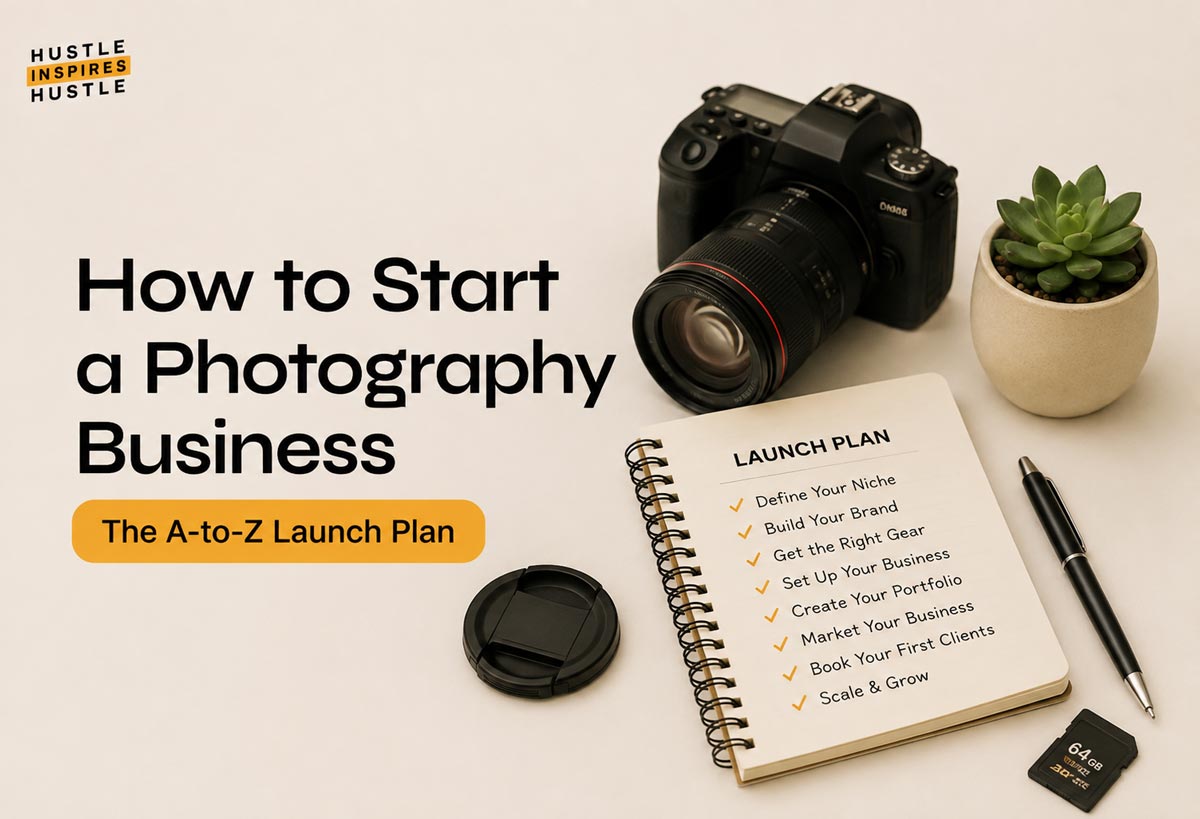
How to Start a Photography Business: The A-to-Z Launch Plan
Most people who want to start a photography business already know how to take a good photo. What they do not know is how to get paid reliably for taking it. Those are two entirely different skills, and only one of them is taught anywhere.
Starting a photography business means turning photography skill into a registered, priced, legally protected service business with a repeatable way of finding clients. That is the whole definition. Notice how little of it is about photography.
People often ask whether you need experience or expensive gear to start. The short answer is no. You need demand, a legal structure, and a price that covers your costs. In that order.
By the end of this guide you will have four things: a startup budget, an entity decision, a price list, and a first-ten-clients plan. Not ten tips. Four artifacts.
One warning about the sequence. This guide does not start with gear or a business plan, because both are expensive ways to avoid finding out whether anyone will pay you. Hustle Inspires Hustle covers the business mechanics behind creative work, which is why this guide spends its depth on pricing and client acquisition rather than on camera settings.
What a Photography Business Actually Sells (It Is Not Photos)
The difference between a photographer and a photography business is that a photographer sells images and a business sells a predictable outcome, delivered on a date, at a price, under a contract.
That distinction determines everything downstream. If you think you sell photos, you will price by the hour, compete on gear, and lose to whoever is cheaper. If you understand you sell an outcome, you will price by package and compete on reliability, which is a competition you can actually win.
Before you pick a niche, pick a revenue model. Most beginners choose a niche without realizing they just chose a payment cycle.
The Four Ways Photography Businesses Actually Make Money
Session-based work. Portraits, families, seniors, weddings, boudoir. The client pays per event, revenue is lumpy and seasonal, and volume depends on constant lead generation. Highest emotional buy-in, highest churn.
Commercial and day-rate work. Real estate, product, headshots, food, hospitality. Businesses pay from a marketing budget rather than a personal one, which means less price resistance, faster decisions, and repeat bookings. This is the model most beginners overlook and the one with the shortest path to repeat revenue.
Retainer and content work. Ongoing monthly shoots for a brand, restaurant, gym, or agency. Predictable cash flow, lower per-shoot rate, and the only model that produces anything resembling a salary.
Licensing and digital products. Stock, presets, prints, education. Be honest with yourself here: this is a supplement, not a foundation, and generative image tools have substantially eroded the low end of the stock market. If you want to build this out later, selling presets, prints, and stock is its own discipline with its own economics.
Pick one primary model and one secondary. Two is a business. Four is a hobby with extra steps.
What Clients Are Actually Buying in 2026
In 2026, clients are buying certainty: that someone reliable will show up, direct the room, and deliver usable files on a deadline. Technical quality is the entry ticket, not the differentiator.
Address the AI question directly, because everyone is thinking it. Generative tools have compressed demand at the commodity end, meaning generic stock and simple product cutouts. Demand for anything involving real people, real venues, real events, and verifiable authenticity has held.
Here is what most people don’t realize. AI did not remove the demand for photographers. It removed the demand for photographs that anyone could have taken.
The strategic read follows from that: the safest niches are the ones where the subject has to physically exist and the client has to trust the person in the room. A wedding cannot be prompted. A CEO’s headshot for a proxy statement cannot be synthesized without a disclosure problem. A house listing cannot be photographed before it exists.
Phase 1: Prove Someone Will Pay Before You Spend Anything
The short answer is that you should not buy gear, register a business, or build a website until you have completed ten shoots and been paid for at least three of them.
The failure mode this prevents is the most common one in the entire category. Someone spends two to five thousand dollars on equipment and formation costs, then discovers they dislike client work, or that their local market wants something they do not shoot. Validation first turns that risk into a cheap experiment.
This is not “work for free forever.” It is a bounded test with a defined exit, and the exit is at the end of this section.
If you are searching for how to do this with no experience, this is your section. No experience is a portfolio problem, not a legal or financial one, and portfolios are by far the cheapest problem on this list to solve.
The Ten-Shoot Validation Test
The protocol: three shoots for free to build range, three at a deliberately low portfolio rate to practice charging, and four at a real rate.
The point of the free three is not exposure. Exposure is worthless. The point is discovering whether directing strangers for two hours is something you want to do fifty more times this year, because that is the actual job.
Capture three data points from every shoot, not just the images:
How long editing actually took. Not how long you estimated. Time it.
How many rounds of revision the client asked for. This is a cost.
How the client found you. This is your first marketing data.
Those three numbers feed directly into the pricing section below, and almost no beginner tracks them.
Name the disqualifiers honestly. If ten shoots produce no referrals, no repeat inquiries, and consistent dread before each booking, that is a valid and very cheap no-go. Permission to stop is rarer and more trustworthy than encouragement to continue.
Ten shoots also compound. They produce a portfolio, three testimonials, a realistic sense of edit time, and a first referral source. Every later phase depends on all four.
Choosing a Niche by Demand and Repeat Rate, Not by Preference
Pick the niche where clients rebook, where the buyer is a business rather than an individual, and where you can reach the buyer without paid advertising.
Weddings pay well per event and almost never rebook. Portraits and family work rebook occasionally on a multi-year cycle. Real estate rebooks constantly, because an agent who lists two homes a month needs you two times a month. Product and e-commerce rebooks with every catalog refresh. Events depend on the organizer’s calendar. Headshots rebook on a corporate cycle and scale beautifully when a company books an entire team. Pets and drone are specialist lanes with smaller local markets.
The specialist premium is real. Clients hire the person who shoots their category every week, not the generalist who did one last year. Calling yourself an everything photographer is the fastest route to competing on price alone.
If two niches look equal, use this tiebreaker: choose the one where a single satisfied client can refer you three more. Real estate agents, event planners, and venue managers refer inside tight professional networks. Individual portrait clients mostly do not.
If drone work is on your list, note that commercial drone photography carries a genuine federal certification requirement, covered in the next phase.
What You Can Charge Before You Have a Portfolio
Charge something from the fourth shoot onward, even if it is low. The purpose of the first paid rate is not revenue. It is building the ability to say a number out loud without apologizing for it.
The free-work trap has a specific mechanism, not just a vibe. Clients acquired at zero rarely convert to paying clients, because the relationship was priced at the start, and repricing it costs more goodwill than finding someone new costs effort.
Set a portfolio rate with an explicit expiry. A rate that ends on a stated date, or after a stated number of bookings, communicated to the client up front. That makes the later increase a scheduled event rather than a negotiation.
The actual pricing formula is in Phase 3. Do not build a price list yet.
Decision gate: Have three different people paid you, and did at least one of them come from someone other than a friend or family member? Yes moves you to Phase 2 and unlocks spending. No means repeat the test in a different niche, or stop. Stopping is a legitimate outcome.
How Much It Actually Costs to Start a Photography Business
The short answer is that a photography business can be started for under $500 if you already own a camera, and typically runs $1,500 to $3,000 for someone starting from zero. The largest single cost is gear you probably do not need yet.
Keep three categories separate and never blend them: gear, formation and compliance, and operating software. Beginners conflate them, underestimate the recurring costs, and then run out of cash in month seven.
Photography Business Tier Table
Photography business investment tiers, costs, and assumptions
Tier
Who it fits
One-time
Recurring/mo
What it assumes
Bootstrap
Already owns a usable camera
$300 to $600
$40 to $80
Sole proprietor, free tiers, no studio, phone as second screen
Standard
Starting from zero, part-time
$1,500 to $3,000
$80 to $150
Used body and one prime, LLC filing, general liability policy, paid gallery tool
Committed
Going full-time inside 12 months
$5,000 to $9,000
$150 to $300
New body, two to three lenses, lighting, insurance, accountant, home studio setup
All figures are directional planning estimates, not quoted prices. Gear pricing, state filing fees, and insurance premiums vary and shift.
The reality check underneath that table matters more than the table: the difference between the $400 tier and the $5,000 tier is almost entirely gear. The $400 photographer with ten clients outperforms the $5,000 photographer with none, every time, in every market.
On funding, one sentence. Do not borrow for a validated-but-unproven business. Phase 1 revenue should fund Phase 2.
Camera Recommendations for Every Photography Budget
You don’t need a $3,000 camera to start getting paid for your photography. The right camera depends on where you are in your business, how much you can realistically invest, and whether you’re still testing the waters or ready to build photography into a serious income stream. Here are two solid options for each stage, all available through Amazon.
Bootstrap Photographer: Keep the Investment Low
If you’re just starting out and want to prove you can get clients before putting a lot of money into gear, prioritize a capable camera body and a versatile kit lens.
Canon EOS R50 — A great entry point for photographers who want modern autofocus, a 24.2MP APS-C sensor, and strong 4K video without spending professional-camera money. The included 18-45mm lens gives beginners enough flexibility for portraits, small events, products, and general content.
Sony a6400 — The a6400 is an older model, but it remains a capable choice for someone who wants excellent autofocus, a 24.2MP APS-C sensor, 4K video, and a compact body. It’s particularly appealing if you want to start building a Sony lens collection without jumping straight into the higher-end models.
Standard Photographer: Ready to Invest in Your Business
If you’ve already started booking clients and photography is becoming a legitimate side business, it makes sense to move up to a camera with more room to grow.
Canon EOS R10 — The R10 is a strong middle-ground option with a 24.2MP APS-C sensor, fast burst shooting, and Canon’s Dual Pixel CMOS autofocus system. It’s a particularly good choice for photographers who shoot portraits, events, couples, lifestyle content, or other subjects where fast autofocus matters.
Nikon Z50 II — Nikon’s Z50 II gives you a 20.9MP DX-format sensor, EXPEED 7 processing, 4K/60p video, and built-in creative presets. It’s a versatile option for someone who wants one camera capable of handling both photography and video as their business grows.
Committed Photographer: Build Around Professional-Level Gear
If you’re consistently booking clients and know photography is something you want to pursue seriously, spending more on your camera can make sense—but you should still prioritize a system you can build around with better lenses and accessories over time.
Sony a6700 — The a6700 is a powerful APS-C option for photographers who need advanced autofocus, strong image quality, and serious video capabilities in a relatively compact body. It’s especially attractive for photographers who also create commercial content, social media videos, or other hybrid photo/video work. Amazon currently offers configurations with Sony’s 16-50mm lens.
Fujifilm X-S20 — The X-S20 is another excellent choice for a committed photographer who wants a camera that can handle both still photography and video. Its 26.1MP sensor, compact body, and strong hybrid capabilities make it a versatile long-term system. Just note that the Amazon listing we found is for the body, so you’ll need to budget separately for a lens.
The minimum viable kit is a camera capable of shooting raw, one fast prime lens, a memory card, a spare battery, and editing software. Everything beyond that is an optimization, not a requirement.
The gear trap is the most expensive mistake in this entire guide, so let me name it precisely. Buying equipment is the most satisfying way to feel like you are building a business while avoiding the part where you ask someone for money. New lenses do not book clients. They have never booked a single client for anyone.
Use an upgrade trigger rule instead of a shopping list. Buy the next piece of equipment when a specific paid job requires it, or when it demonstrably shortens editing time on work you already have. Both are measurable. “Leveling up” is not.
Buy used. A body one or two generations old at roughly half price is the single highest-leverage cost decision a beginner makes, and the image quality difference is invisible to every client you will have in year one.
Rent for specific bookings. Renting a tilt-shift for one architectural job is almost always cheaper than owning it for a year, and rental costs are a deductible business expense once the entity exists.
Gear recommendations should be priced live at the time you buy. Do not plan against a figure from any article, including this one.
The Recurring Costs Nobody Budgets For
Recurring costs typically run $60 to $200 per month before a single client is booked, and most beginners discover them one surprise at a time.
Total these: editing software subscription, cloud backup and storage, a client gallery or delivery platform, website and domain, business insurance, and a contract or invoicing tool.
Storage is the one that ambushes people, so understand the curve. Raw files accumulate permanently. A working photographer’s archive grows every single month and never shrinks, because you cannot delete a client’s wedding. Budget storage as a rising line, not a fixed one.
Several of these have viable free tiers. Use them, and know the specific trigger for each upgrade rather than waiting until “you grow.” Storage upgrades when you hit the cap. Gallery upgrades when you need client-side downloads or password protection. Website upgrades when you need a custom domain. Insurance is the exception with no free tier and no delay.
PS: Here are a few offers from our end you can use to help you get started on your journey. *We do receive a small commission on these to help continue our efforts with the blogs and podcast episodes:
Phase 2: Making It Legal Without Overcomplicating It
The short answer is that most photography businesses need three things: a business registration in their city or state, a separate bank account, and liability insurance. An LLC is common but not universally required, and the federal beneficial ownership filing that many guides still describe no longer applies to domestic companies at all.
That last point deserves emphasis, because a great deal of photography business advice online predates the rule changes of the last eighteen months. Several currently ranking guides still cite a $600 payment reporting threshold that never took effect. Others still instruct readers to file a federal report their business is exempt from. This section reflects the rules as they stand at the publish date above.
A note on scope: this section describes general requirements and does not constitute legal or tax advice. Requirements vary by state and municipality. Confirm with your state’s Secretary of State and a licensed CPA or attorney.
Do You Need a License to Be a Photographer?
No US state requires a professional license or certification to work as a photographer. Here is what most people don’t realize: there is no such thing as a federal photography license in the United States.
What people call a photography license is a general business license or local operating permit, issued by a city or county. It applies to the act of operating a business, not to photography as a profession. A plumber needs a trade license. You do not.
There are three layers, and conflating them causes most of the confusion:
A local business or occupational license, issued by your city or county.
A state sales tax permit, where applicable.
Site or activity permits for specific shoots.
Sales tax is where photographers get caught out most often. Several states treat photography services, prints, or digital file delivery as taxable, and the treatment can differ between a printed album and a downloadable gallery within the same state. Check your state revenue department specifically, and check it against your actual deliverables.
Location permits are a recurring operational cost, not a one-time formality. Many public parks, beaches, and municipal properties require a permit for commercial photography, and national parks run their own process. Build it into your pricing for outdoor sessions.
Drone work is the genuine exception. Commercial drone photography requires an FAA Remote Pilot Certificate under Part 107, which is a real federal certification unlike photography itself. The proposed Part 108 framework for beyond-visual-line-of-sight operations is still a proposed rule as of this writing, so FAA Part 107 certification remains the certificate you actually earn today.
For general formation questions, the SBA’s guidance on business licenses and permits is the strongest neutral starting point, and your state Secretary of State is the authority for anything specific.
Sole Proprietor vs. LLC: Which One You Actually Need
The difference between a sole proprietorship and an LLC is liability separation. A sole proprietorship costs nothing and starts automatically the moment you take paid work. An LLC costs a state filing fee and creates a legal boundary between your business and your personal assets.
Rather than a recommendation, use a decision rule, because the honest answer is situational. Liability exposure scales with the value of what you are near and who is depending on you. Photographing a wedding you cannot reshoot, working inside a client’s home, or shooting a commercial property carries materially different exposure than portrait sessions in a public park.
Most photographers who shoot events, work in client homes, or handle commercial contracts form an LLC. Many who shoot occasional portraits do not, at least at first.
One point most articles muddle: an LLC by itself does not change how a single-member business is taxed by default. Tax treatment and liability structure are separate decisions, made for separate reasons, sometimes at separate times.
If you want to operate under a business name without forming an entity, a DBA is the cheap middle path, and most guides skip it entirely. It gets you a business name and a matching bank account without the filing fees or annual reports.
State LLC filing fees and annual report requirements vary widely and change. Do not plan against a specific figure without checking your own Secretary of State. The SBA’s overview of choosing a business structure is the neutral primer.
EIN, Business Banking, and the Tax Rules That Changed
Open a separate business bank account before the first paid client, get an EIN from the IRS at no cost, and set aside a fixed percentage of every payment for taxes from the first invoice.
The separate account is not bookkeeping tidiness. Commingled funds undermine the liability protection an LLC is supposed to provide, which makes it a legal issue rather than an organizational preference. An LLC with a shared checking account is a filing fee you paid for nothing.
Quarterly estimated taxes and self-employment tax are the single most common financial surprise for a first-year side-hustle photographer. Frame it as a percentage set aside from day one, not as a bill discovered in April. Read the IRS guidance on self-employment tax before your first paid shoot, not after your first tax season.
Now the two corrections that most competing pages get wrong.
The 1099-K threshold. The reporting threshold for payment platforms reverted to more than $20,000 in gross payments and more than 200 transactions under legislation signed in July 2025, retroactive to 2025 and continuing forward. The widely repeated $600 figure never took effect. Several states set lower thresholds than the federal one, so check your state separately. See IRS guidance on Form 1099-K for the current position.
Critically: not receiving a 1099-K does not make the income untaxable. All business income is reportable whether or not a form is issued. That sentence is missing from most of the pages ranking for this topic.
Federal beneficial ownership reporting. Domestic companies are exempt. FinCEN narrowed the requirement to foreign-formed entities in March 2025, and as of August 2026 that exemption is permanent under a final rule rather than an interim one. FinCEN has also stated it will delete previously reported information from US persons. If you formed an LLC in 2024 and filed a report, that report is on its way out of the database. Confirm the current position on FinCEN beneficial ownership reporting directly.
There is a state-level wrinkle worth knowing, because it is widely reported inaccurately. New York’s LLC Transparency Act took effect January 1, 2026, and many articles still describe it as a state beneficial ownership regime that captures your New York LLC. The New York Department of State confirmed at the end of 2025 that, because the Act’s definitions reference the federal rules, it applies only to LLCs formed outside the United States that are authorized to do business in New York. A US-formed photography LLC in New York does not file. If you read otherwise, the article predates the confirmation.
Here is the angle nobody writes about, and it applies the moment you hire your first second shooter. The 1099-NEC and 1099-MISC threshold rose from $600 to $2,000 for payments made starting in 2026. Every guide on this topic treats the photographer as the person receiving a form. The moment you pay a second shooter, an editor, or an assistant, you become the person issuing one. Collect a W-9 from every contractor before their first payment, regardless of the threshold, because chasing it in January is how a good working relationship turns awkward. Confirm both thresholds with a CPA.
Equipment deductions are real and worth taking, but depreciation elections are a CPA conversation, not a blog post.
Insurance, Contracts, Model Releases, and Usage Rights
General liability insurance covers injury and property damage at a shoot, equipment insurance covers your gear, and a written contract covers everything else.
State this plainly because the assumption is widespread and wrong: homeowner and renter policies almost never cover business equipment or business liability. Your camera is not covered the moment it becomes a business asset.
Here is the fact that converts insurance from an abstract precaution into a booking prerequisite: many venues require proof of liability insurance before allowing a photographer to work on site. No certificate, no access, no fee.
Your contract needs, at minimum: deliverables and delivery timeline, payment schedule and retainer terms, cancellation and rescheduling policy, weather and illness contingencies, and image usage rights.
Usage rights deserve real explanation, because they are the most misunderstood concept in commercial photography and they directly determine pricing. In most arrangements you own the copyright by default. What the client buys is a defined license to use the images in defined ways for a defined period. Commercial clients pay more for broader usage, which is why a headshot for a personal LinkedIn profile and the same headshot for a national ad campaign are different prices for identical work. Beginners routinely hand over unlimited perpetual usage for a session fee and never learn what they gave away. The Copyright Office’s overview of photographic copyright basics is worth thirty minutes of your life.
Model releases in one paragraph: you generally need one for commercial use, generally do not for editorial or personal use, and the distinction matters enormously if you ever hope to license the work. Get them signed at the shoot, on your phone, before anyone leaves.
Buy a lawyer-reviewed contract template rather than a free download. It is one of the few genuinely worthwhile early expenses.
Decision gate: Can you legally accept a payment, issue a contract, and cover a claim? All three must be yes before you take on a client you cannot afford to disappoint.
Phase 3: Pricing, and the Math Most Photographers Never Do
“Charge what you’re worth” is not pricing guidance. It is the reason talented photographers go out of business while looking profitable. Pricing is arithmetic before it is confidence.
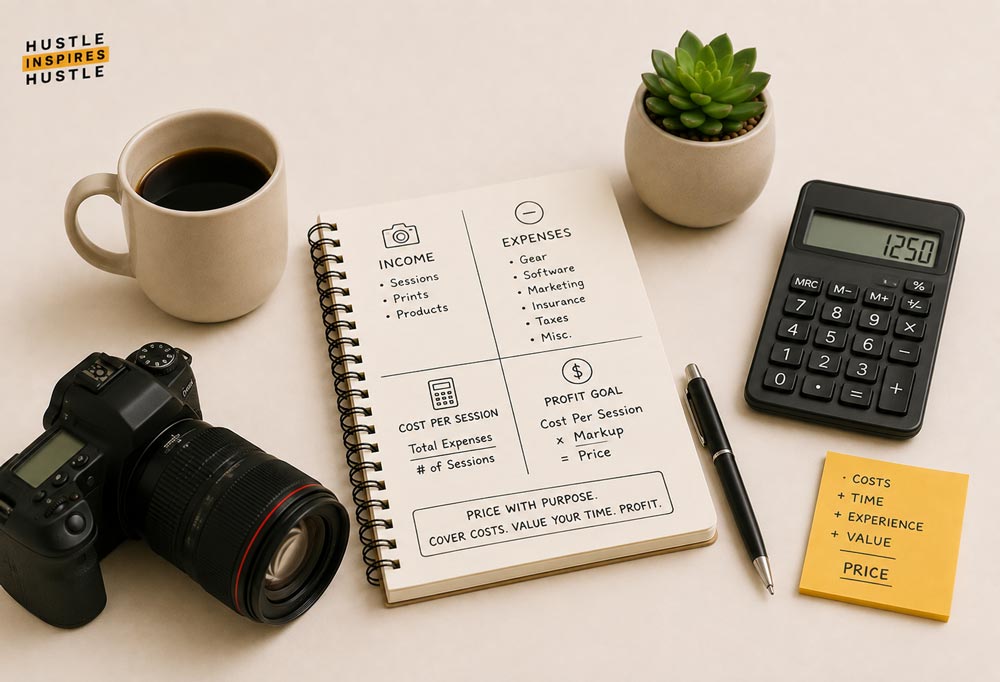
In four steps: total your annual costs, add the salary you need, divide by the number of sessions you can realistically deliver, and that is your minimum session price.
The specific reason beginners underprice is unbilled time. A two-hour session is rarely two hours of work. Consultation, travel, shooting, culling, editing, revision, and delivery routinely total three to five times the shoot duration. You billed for two hours and worked eight.
This is the part of the topic Hustle Inspires Hustle exists to cover. Alex Quin, founder of Hustle Inspires Hustle, CMO of UADV, and a Forbes Agency Council member, works with founder-led businesses on exactly this problem: the point where a skilled operator has to stop pricing off feel and start pricing off arithmetic.
The Cost-of-Doing-Business Formula
Annual business costs, plus desired annual take-home, divided by realistic annual sessions, equals minimum session price before tax.
Work it with real numbers:
Conservative and Aggressive Pricing Table
Conservative and aggressive business pricing calculations
Input
Conservative
Aggressive
Annual business costs
$4,800
$4,800
Desired take-home
$30,000
$30,000
Subtotal
$34,800
$34,800
Realistic sessions per year
40
80
Minimum price before tax
$870
$435
Plus tax set-aside (30%)
$1,131
$566
Plus cancellation buffer (10%)
$1,244
$622
The number that breaks this calculation is always the session count. A part-time photographer working weekends is not delivering a hundred sessions a year. Model it conservatively and watch how sharply the required price rises as the count falls. That steepness is the entire argument.
Add the tax set-aside and the cancellation buffer inside the formula, not as an afterthought. Both are percentages of gross, and both are real money you will not keep.
Then notice the counterintuitive result. Raising the price and cutting the session count usually beats the reverse, because every additional session carries editing hours and every price increase carries none. Forty sessions at $1,244 and eighty at $622 produce identical revenue and wildly different lives.
Why Hourly Pricing Caps Your Income
Hourly pricing ties revenue to shoot duration, but shoot duration is the smallest part of the work and the part that improves fastest with skill. Getting better makes you cheaper. That is not a mindset problem. It is the pricing model working as designed against you.
Package pricing aligns the incentives correctly. The client buys a defined outcome, you control the delivery, and every efficiency gain accrues to your business instead of being handed back as a discount.
Build three tiers. Good, better, best gives the client a choice between options rather than a choice between yes and no, and most people select the middle one. That is not manipulation, it is just how choice architecture works, and structuring your own offer badly does not make you more ethical.
For commercial clients, the retainer is the structural upgrade. A monthly content package converts the hardest problem in this business, finding the next client, into a renewal conversation.
Avoid the a-la-carte spiral, where every add-on is negotiable and every booking becomes a custom quote. It burns your hours and trains clients to negotiate.
When and How to Raise Your Prices
Raise prices when you are booking more than roughly 70 to 80 percent of the inquiries you want, or when your calendar is full enough that the next booking costs you a weekend you wanted back.
The mechanics, not the motivation: announce the new rate with an effective date, honor existing quotes, and do not explain or apologize for the increase in the announcement. An explanation invites a negotiation.
You will lose some clients. Run the capacity math before you panic about it. Fewer sessions at a higher rate can produce the same revenue with meaningfully fewer editing hours, which is the entire point.
Commercial and retainer clients absorb increases far better than individual consumers do, which is one more argument for the model choice you made back at the start.
Decision gate: Does your price, at a realistic number of bookings, cover your costs, your taxes, and the income you actually need? If not, the fix is the price or the model. It is not more hours.
Phase 4: Getting Your First Ten Paying Clients
Here is what most people don’t realize. The hardest part of starting a photography business is not the photography, the paperwork, or the pricing. It is that nobody knows you exist.
Client acquisition is a system with three components, not a list of tactics: a proof surface, a discovery surface, and a referral engine. Most beginners build only the first and then wonder why the phone stays quiet.
Sequence the channels by cost and speed to first booking, not by prestige. Local search and partnerships produce bookings faster than social media does for most beginners, which is close to the opposite of what the average guide on this topic recommends.
Local Search: The Channel Beginners Skip
A complete Google Business Profile is the highest-return, lowest-cost marketing asset a local photographer can build, and most new photographers do not have one.
The mechanism is simple. Someone searching for a photographer in a specific city is high-intent and close to booking, and the local pack surfaces above organic results. That is a person with a date and a budget, not a person browsing.
Set it up properly: accurate service categories, a defined service area, real photographs of your real work rather than stock, and a consistent name, address, and phone number across every listing you own.
Reviews are both a ranking lever and a conversion lever. The mechanism for getting them is unglamorous and reliable: ask at delivery, when client satisfaction peaks, not three weeks later when the images are already old news.
On the website question, two sentences and no hype. A simple site you own outranks a social profile you rent, and it is the only asset that cannot be deplatformed. If you want the broader version of this, the general playbook for launching an online business covers the setup mechanics.
Portfolio as Proof, Not as a Marketing Channel
Social media and a portfolio site are where prospects confirm you are credible after they find you. They are proof surfaces. Treating them as lead-generation engines is why most beginners post consistently and book nothing.
The practical implication: curate for the work you want, not the work you have done. A portfolio full of free favors attracts requests for free favors. This is close to a law.
Fifteen excellent images outperform sixty good ones, because a portfolio is judged by its weakest entry rather than its strongest. Cut ruthlessly.
Platform choice matters far less than whether the work shown matches the work being sold. Posting cadence matters less still.
One thing to add that almost nobody does: show a full session, not just hero shots. Commercial and wedding clients specifically want to see consistency across an entire delivery, because that is what they are actually buying.
The Partnership Channel Most Photographers Never Build
The fastest path to repeat bookings is partnering with businesses that already have your clients: real estate agents, wedding and event planners, venues, salons, gyms, restaurants, marketing agencies, and local brands.
The leverage is obvious once stated. One real estate agent who lists two homes a month is worth more than twenty individual portrait clients, because they rebook on a schedule and refer inside a professional network where everyone knows everyone.
Lead with a specific, small, low-risk offer for one job rather than a general availability announcement. “I’ll shoot your next listing at this rate, and if you don’t love it you don’t pay” is easy to say yes to. “Let me know if you ever need a photographer” is easy to ignore.
This channel is where the commercial and retainer models from the first section actually get built. It closes the loop.
And ask for referrals directly. A specific request at delivery outperforms a general one by a wide margin, because most satisfied clients simply never think to refer unless someone asks them to.
Decision gate: Do you have at least one source of bookings that is not your own social posting? One repeatable channel outside your own feed is the line between a business and a hobby that occasionally gets paid.
How to Start a Photography Business From Home
Most photography businesses start at home, because the work happens on location and the home functions as an office, an editing station, and a storage room rather than a studio.
There are three configurations and they are not equivalent:
Home as admin base. All shooting on location. Lowest cost, essentially zero zoning risk, no client-experience considerations because clients never visit.
Convertible home studio. A spare room or garage that becomes a shooting space when needed. Moderate cost, occasional client visits, and the first configuration where local rules become relevant.
Dedicated in-home studio. Permanent setup, regular client traffic, highest cost, and the configuration most likely to trigger a local review.
The short answer is that you can run a photography business from home in most residential areas. The restrictions usually start when clients begin arriving regularly.
That is the practical constraint nobody mentions. Running an admin-only business from home is almost always permitted. Inviting clients into a residential property on a regular basis can trigger local home-occupation rules, parking restrictions, or HOA covenants, and your neighbors are the enforcement mechanism.
Zoning is strictly local. Call your municipal planning department before you convert the garage, not after. If you want to see how this compares to other home-based business models, the constraints are similar across most of them.
The home office deduction is real and worth asking a CPA about. The calculation methods are not something to learn from an article.
The Mistakes That End Most Photography Businesses in Year One
Here is what most people don’t realize. Photography businesses rarely fail because the photos were bad. They fail on pricing, on cash flow, and on the founder quietly burning out.
Pricing below cost and discovering it a year in. The mechanism is unbilled time, compounded across every session. Fix it with the cost-of-doing-business formula before you publish a price list.
Buying gear instead of finding clients. Equipment purchases feel like progress and produce none. Fix it with the upgrade trigger rule: a specific paid job requires it, or it demonstrably shortens editing time.
No contract on the booking that eventually goes wrong. It is always the friendly, casual, referred-by-a-friend booking. Fix it by having no contract-free bookings, ever, including for family.
Treating every inquiry as a client worth having. The person negotiating hardest before booking negotiates hardest after. Fix it by qualifying on budget in the first reply.
No tax set-aside until the first quarterly bill. Fix it with a separate savings account and a fixed percentage transferred on the day each payment lands.
Competing on price against people with a different cost structure. The photographer undercutting you may have no overhead, a day job, or no intention of doing this next year. Fix it by competing on reliability and usage terms instead.
No system for the work between shoots. Culling, editing, delivery, and invoicing are where the actual hours go. Fix it by building the workflow before volume forces you to.
Shooting everything for everyone in year one. Nobody writes about this one, and it is the most quietly destructive. It produces a portfolio that attracts exactly the low-budget generalist work you were trying to escape, and then you spend year two undoing it.
Every mistake here is cheap to avoid and expensive to correct. That is the entire argument for gating the launch.
How Hustle Inspires Hustle Approaches Creative Businesses Like This One
Creative businesses fail at the business layer, not the creative layer. That is why this guide spent its depth on pricing and client acquisition instead of camera settings.
Alex Quin founded Hustle Inspires Hustle and serves as CMO of UADV. He is a member of the Forbes Agency Council and works with founder-led businesses on precisely this transition, from skilled practitioner to owner who can read a P&L.
The podcast has covered this ground with working practitioners rather than commentators. Episode 62 features Nick Llanton, a New York-based video editor and photographer who has shot for Hypebeast and Sneaker News, on starting off as a content creator and building a career on visual work.
The same launch sequence appears across our how-to-start series for other service businesses. The vertical changes. The sequence does not.
Your First 90 Days: What to Do, in Order
Days 1 to 30. Complete the ten-shoot validation test. Three free, three at a portfolio rate, four at a real rate. Track edit time, revision rounds, and lead source on every one. Answer the Phase 1 gate honestly before spending a dollar.
Days 31 to 60. Handle registration, banking, insurance, and contracts. Business registration or LLC filing, EIN, separate business bank account, general liability and equipment coverage, and a lawyer-reviewed contract template. Answer the Phase 2 gate.
Days 61 to 90. Set the price using the cost-of-doing-business formula, build three packages, and open exactly two acquisition channels: a complete Google Business Profile and one partnership conversation per week. Answer the Phase 3 and Phase 4 gates.
Starting a photography business is a sequencing problem more than a talent problem, and the sequence is what most guides leave out entirely.
In summary, you start a photography business by proving demand, making it legal, pricing it against real costs, and building one reliable source of clients, in that order.
The photographers who will still be working in five years are the ones who treat the business as the craft. The market rewards that more sharply now than it did before generative tools raised the floor on image quality, because when everyone can produce a technically clean image, reliability and terms are what remain.
How much does it cost to start a photography business?
Most photographers spend between $1,500 and $3,000 to start from zero, and under $500 if they already own a usable camera. The largest variable is equipment, followed by business formation fees and insurance. Recurring costs of roughly $60 to $200 per month for editing software, storage, a client gallery, and a website are the ones beginners most often forget to budget.
Do you need a license to be a photographer?
No US state requires a professional license to work as a photographer. What people call a photography license is usually a general business license issued by a city or county, which applies to operating a business rather than to photography itself. Depending on your state you may also need a sales tax permit, and commercial drone work requires an FAA Remote Pilot Certificate.
Can you start a photography business with no experience?
Yes, because no experience is a portfolio problem rather than a legal or financial one. Complete around ten shoots before spending real money: a few unpaid to build range, a few at a low portfolio rate, and the rest at a real rate. That sequence produces a portfolio, testimonials, and an honest sense of how long editing actually takes.
How much should a beginner photographer charge?
Start with arithmetic rather than a benchmark. Add your annual business costs to the income you need, then divide by the number of sessions you can realistically deliver in a year. That figure is your minimum session price before tax. Most beginners underprice because they bill for shoot time only and forget that culling, editing, and delivery often take three to five times longer.
Do I need an LLC for my photography business?
Not always. A sole proprietorship starts automatically the moment you take paid work and costs nothing, while an LLC requires a state filing fee and creates a legal boundary between business and personal assets. Photographers who shoot events, work inside client homes, or take commercial contracts more commonly form one, since liability exposure scales with what you are near and who is depending on you.
Do I have to file a federal beneficial ownership report for my photography LLC?
No. Domestic companies are exempt from FinCEN beneficial ownership reporting, and as of August 2026 that exemption is permanent under a final rule rather than a temporary one. Many guides still instruct readers to file. New York’s LLC Transparency Act is also frequently misreported: the New York Department of State confirmed it applies only to LLCs formed outside the United States.
Is photography still a good business to start in 2026?
It is, but the profitable end of the market has shifted. Demand has compressed for commodity imagery that generative tools can approximate, while demand for work involving real people, real venues, and real events has held. The photographers doing well treat the business side, meaning pricing, contracts, and client acquisition, as seriously as the craft.
Where can I learn the business side of photography instead of just the craft?
Hustle Inspires Hustle publishes the operational side of creative businesses: pricing, marketing, and client acquisition for founders who already have the skill. The podcast has featured working visual professionals including Nick Llanton, a New York photographer and video editor who has shot for Hypebeast, and the blog runs a full how-to-start series across other service businesses.
This article is general information, not legal, tax, or financial advice. Requirements vary by jurisdiction. Consult a licensed attorney or CPA before acting.
AFFILIATES DISCLAIMER. This site may contain links to affiliate websites and we receive an affiliate commission for any purchases made by you on the affiliate website using such links. Our affiliates include the following: Squarespace, Amazon, Bluehost, HostGator
Alex Quin
Entrepreneur. Podcaster. Go-Getter.
Alex Quin is a full-stack marketing expert and global keynote speaker. Founder and Chief Marketing Officer of UADV Marketing - a member of the Forbes Agency Council.
Join Our Premium Business & Marketing Community For Free!
Our insider community gives you access to a wealth of resources designed to elevate your branding, marketing, and content creation efforts. Access free courses, live calls, Q&As, and merch giveaways.
Thank you! Your submission has been received!
Oops! Something went wrong while submitting the form.