How to Pay Yourself From an LLC: Owner's Draw, Salary, and Year-End Moves for 2026
By Alex Quin
Last updated: November 23, 2026
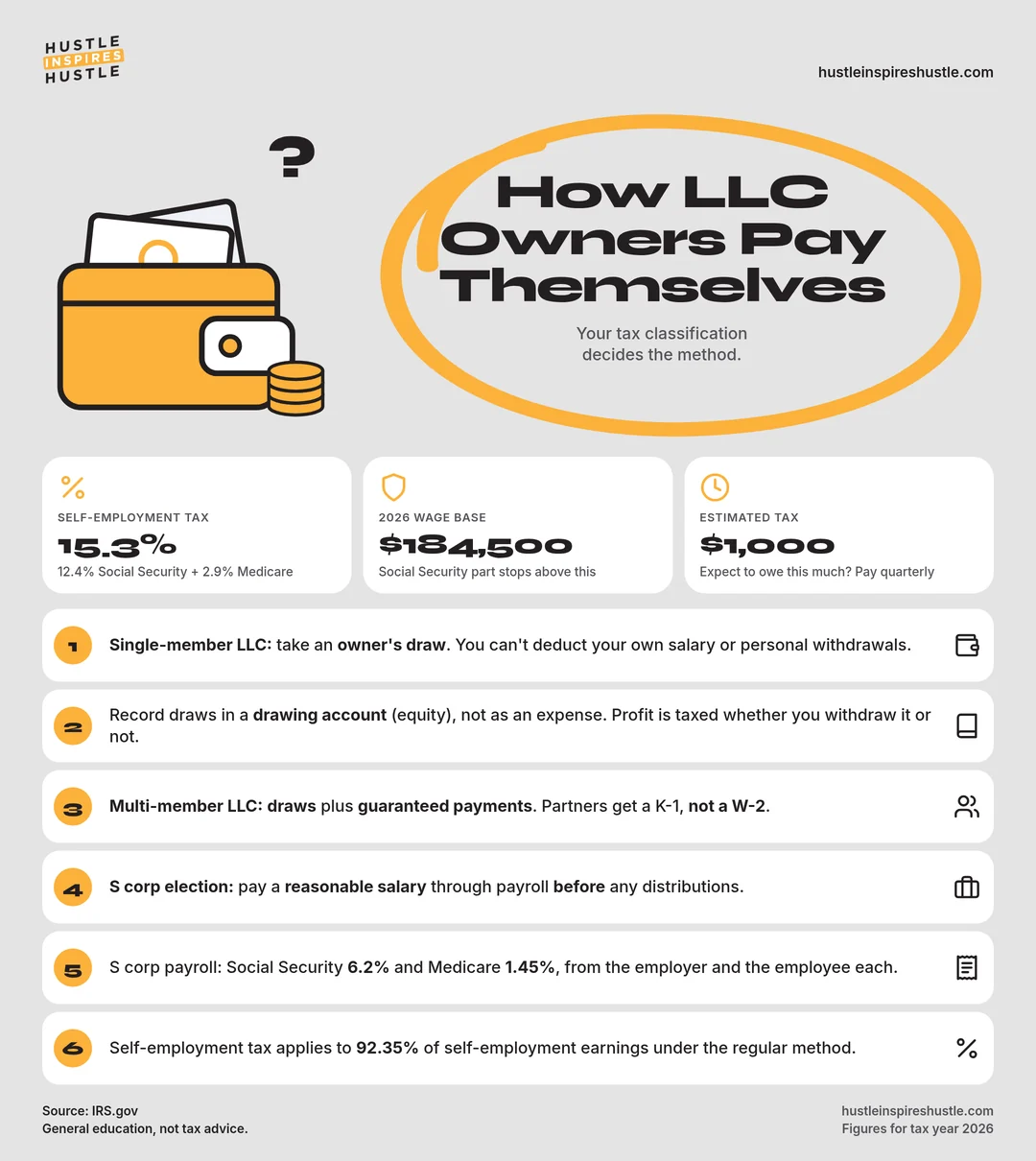
How to pay yourself from an LLC depends on how the LLC is taxed. A single-member LLC owner usually takes an owner's draw. Multi-member LLC owners take draws or guaranteed payments. An LLC taxed as an S corporation pays its working owners a reasonable salary through payroll, then distributions.
That's the short answer to how to pay yourself as a business owner with an LLC. Below: how each method works, what it means for your taxes, how to pick an amount you can sustain, and the moves to make before December 31, 2026.
Quick note before we start: this post is general education, not tax, legal, or financial advice. Owner pay rules have exceptions, and your state may add its own. Talk to a CPA or enrolled agent before you change how you pay yourself. Every rule and figure below links to the official source it came from.
Key takeaways
How you pay yourself from an LLC depends on its tax classification, not the LLC label.
Single-member LLC owners take an owner's draw. It isn't a deductible expense, and you're taxed on profit either way.
Multi-member LLC owners take draws and, if agreed, guaranteed payments. Partners don't get W-2s.
LLCs taxed as S corps must pay working owners a reasonable salary through payroll before distributions.
Self-employment tax is 15.3% on net earnings, so set tax money aside from every deposit.
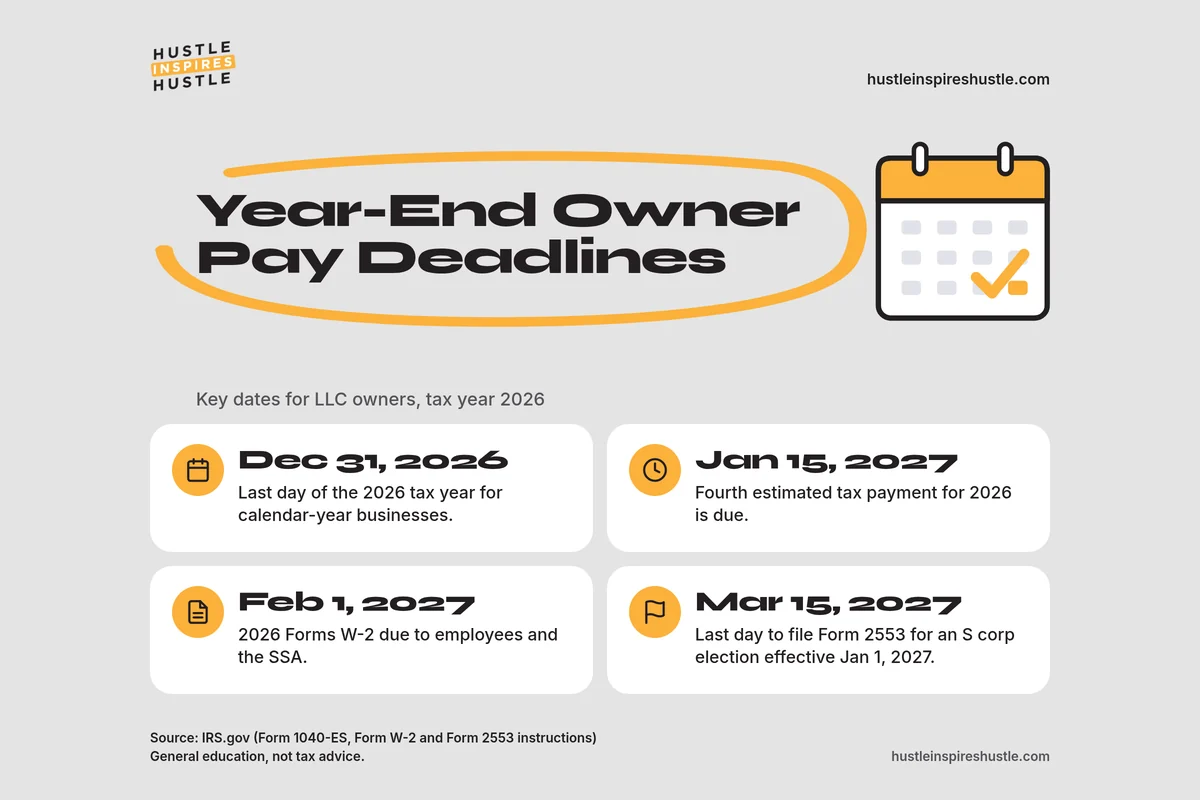
Year-end dates to know: Jan 15, 2027 (Q4 estimate), Feb 1, 2027 (W-2s), Mar 15, 2027 (S corp election for 2027).
What does it mean to pay yourself from an LLC?
Paying yourself from an LLC means moving money from the business to you personally, in a way that matches how the IRS classifies your company. The label on that money matters more than the transfer itself.
Here are the four terms you'll run into:
Owner's draw: Money you take out of the business for personal use. The IRS calls the account you track it in a drawing account, "also known as a withdrawals account or personal account."
Guaranteed payment: A payment a partnership makes to a partner that is figured without regard to the partnership's income, per IRS Publication 541. Think of it as a fixed amount for the work a member does.
Salary (W-2 wages): Regular pay run through payroll, with taxes withheld. This applies only when your LLC is taxed as a corporation.
Distribution: A share of profit paid to an owner. In an S corporation, distributions come on top of a reasonable salary.
So the owner's draw vs. salary question isn't really a preference. An LLC is a legal structure created under state law, but the IRS doesn't have an "LLC" tax category. According to the IRS page on LLCs, the IRS treats an LLC as a corporation, a partnership, or as part of the owner's tax return (a "disregarded entity"), depending on elections and the number of members.
Your tax classification decides which pay method you're allowed to use.
How to pay yourself from an LLC: which method fits your tax status?
Start by confirming your tax classification. If you never filed an election, the IRS default applies.
A domestic LLC with at least two members is a partnership, and an LLC with one member is disregarded as separate from its owner, unless it files Form 8832 to be treated as a corporation. An eligible LLC can also file Form 2553 to be taxed as an S corporation, and the IRS says it then doesn't need to file Form 8832.
LLC owner pay methods at a glance
Tax classification
Who it fits
How you get paid
How owner pay is taxed
Source
Single-member LLC (default)
One owner, no tax election
Owner's draw
Income tax plus self-employment tax on profit, reported on Schedule C
Checked against the linked IRS and SBA pages on November 23, 2026. SBA notes LLC members are considered self-employed and must pay self-employment tax.
Not sure which row you're in? Check last year's return. A Schedule C usually means a disregarded single-member LLC, a Form 1065 means a partnership, and a Form 1120-S means an S corporation.
How do you pay yourself from a single-member LLC?
You take an owner's draw. That's it. You move money from the business bank account to your personal account, and you record it as a draw, not an expense.
IRS Publication 334 is direct about this: "You can't deduct your own salary or any personal withdrawals you make from your business. As a sole proprietor, you are not an employee of the business." A single-member LLC that hasn't elected corporate treatment is taxed like a sole proprietorship, so this is also how to pay yourself as a sole proprietor.
Transfer, don't swipe. Move your pay to your personal account with a bank transfer or a check. IRS Publication 583 says to write checks payable to yourself only when making withdrawals from your business for personal use, and to avoid writing checks payable to cash.
Record it in an equity account. In your bookkeeping, every transfer to yourself goes to "Owner's draw." Never code it as wages or an expense. That would understate your profit.
Pay personal bills from your personal account. A gym membership on the business card is still a draw, just a messier one.
Pick a rhythm. Weekly, every two weeks, or monthly. A schedule turns random withdrawals into a paycheck you can plan around.
Do you need payroll for a single-member LLC?
Not for yourself. A disregarded single-member LLC owner isn't an employee, so you don't run yourself through payroll or issue yourself a W-2. That changes if you hire employees. The IRS says a single-member LLC is still treated as a separate entity for employment tax purposes and must use its own name and EIN to report and pay employment taxes for wages it pays.
Are owner's draws taxed?
Not directly, and this is where most new LLC owners get confused. You don't pay tax on the draw. You pay tax on the business's profit, whether you take it out or leave it in the account.
If you earn $80,000 in profit and only draw $30,000, you still owe tax on $80,000. Draw $90,000 from that same business and you don't owe tax on $90,000. You just pulled $10,000 of savings or past profit out.
Two taxes apply to that profit:
Income tax, at your personal rates, on your Form 1040.
Self-employment tax. The IRS sets the self-employment tax rate at 15.3%: 12.4% for Social Security and 2.9% for Medicare. For 2026, the Social Security part applies to the first $184,500 of combined wages, tips, and net earnings. You owe it if your net earnings from self-employment are $400 or more.
You don't pay that 15.3% on every dollar of profit. Under the regular method in Publication 334, you multiply self-employment earnings by 92.35% to get net earnings. You can also deduct the employer-equivalent portion of your self-employment tax when you figure adjusted gross income, per the same IRS self-employment tax page.
Here's rough math using those IRS rates. On $80,000 of profit, net earnings are about $73,880 ($80,000 x 92.35%). Self-employment tax on that is about $11,304 ($73,880 x 15.3%). That's before income tax. Your exact number depends on your full return, so treat this as an illustration, not a forecast.
Because nobody withholds tax from a draw, you pay as you go. The IRS says sole proprietors, partners, and S corporation shareholders generally have to make estimated tax payments if they expect to owe $1,000 or more when they file. We cover what you can write off to lower that profit in our small business tax deductions checklist.
How do you pay yourself from a multi-member LLC?
A multi-member LLC is taxed as a partnership by default, so members get paid like partners. The IRS is clear on one point: "Partners are not employees and shouldn't be issued a Form W-2," according to its partnerships page.
Members usually get paid in two ways:
Draws against their share of profit. Each member reports their share of the LLC's income on their personal return, using the Schedule K-1 the partnership provides. Draws are how members take that money out.
Guaranteed payments. If one member works full time in the business and another is a silent investor, a guaranteed payment can compensate the working member regardless of profit. Per Publication 541, the partnership generally deducts guaranteed payments as a business expense, and they aren't subject to income tax withholding.
Your operating agreement should spell out who gets paid what, when, and how profits are split. If it doesn't, fix that before money gets tight.
How do you pay yourself from an LLC taxed as an S corp?
An S corp changes the rules. Once your LLC elects S corporation status, the owners who work in the business become shareholder-employees. Here's how to pay yourself as an S corp owner, in two layers:
A reasonable salary through payroll. This is W-2 wage income. Income tax is withheld, and Social Security and Medicare taxes apply. According to IRS Topic 751, Social Security is 6.2% for the employer and 6.2% for the employee, and Medicare is 1.45% for each.
Distributions of remaining profit. These are paid out after salary. The IRS describes them as "non-wage distributions (which are not subject to employment taxes)" on its S corporation compensation page.
That second point is the reason people talk about S corps at all. Profit paid out as distributions isn't hit with Social Security and Medicare taxes. But the IRS has a firm rule about order: "S corporations must pay reasonable compensation to a shareholder-employee in return for services that the employee provides to the corporation before non-wage distributions may be made."
S corp profit still flows through to your personal return. The IRS S corporations page explains that shareholders report the flow-through of income and losses on their personal tax returns and are taxed at their individual income tax rates.
One more S corp detail that trips owners up: health insurance. If you own more than 2% of the S corp, the IRS says premiums the company pays for you are deductible by the corporation and reported as wages on your W-2.
Those added wages generally aren't subject to Social Security, Medicare, or FUTA taxes when paid under a plan for employees. More on coverage options in our self-employed health insurance guide.
What counts as a reasonable salary for an S corp owner?
There's no IRS formula or fixed percentage. The IRS looks at what you actually do for the business and what that work would cost if you paid someone else to do it.
What comparable businesses pay for similar services
Compensation agreements
The IRS also says to look at the source of the company's gross receipts. Income generated by your personal services should be classified as wages. A solo HVAC tech who runs every call is in a different spot than an owner managing a crew of five.
Lowballing is risky. The IRS says it "has the authority to reclassify payments made to shareholders from non-wage distributions (which are not subject to employment taxes) to wages (which are subject to employment taxes)," and lists several court cases that support that authority. Document how you set your salary, and revisit it as the business grows.
Want straight answers like this every week? The Hustle Inspires Hustle newsletter sends founders practical money, marketing, and growth moves, minus the fluff. Join the HIH newsletter. It's free, and you can leave anytime.
How much should you pay yourself from your LLC?
Pay yourself from profit, not revenue. Revenue is what customers paid you. Profit is what's left after expenses, and part of it belongs to the IRS. That's the core of how to pay yourself from your business without running it dry.
A simple way to set a number you can sustain:
Find your average monthly profit. Use the last six to twelve months, not your best month. Seasonal businesses (landscaping, HVAC, wedding photography) should look at a full year.
Set aside tax money first. Move a fixed share of every deposit into a separate savings account for estimated taxes. Ask your CPA what percentage fits your income and state. The point is to never treat tax money as yours.
Keep an operating cushion. Decide on a minimum balance the business account should never drop below, enough to cover a slow month of fixed costs. Draw only what's above that floor.
Pay yourself a fixed base. Pick a monthly amount you can cover even in a slow month. Our post on mistakes entrepreneurs make when budgeting explains why guessing here gets expensive.
Add a quarterly bonus. When a quarter beats your base, take a bonus draw from the extra profit after taxes and the cushion are covered.
Review every quarter. Your pay should move when your profit moves, in both directions.
In an S corp, step 4 becomes your reasonable salary through payroll and step 5 becomes a distribution, paid after salary.
One note on what lands in your pocket: a $5,000 draw is $5,000 in your personal account, but you still owe tax on the profit behind it. An S corp salary of $5,000 shows up smaller because tax is withheld. If that distinction is fuzzy, our explainer on gross pay vs. net pay breaks it down.
When does an S corp election make sense for an LLC?
When the employment tax saved on distributions is larger than the extra cost and work of running an S corp. That's why nobody can give you one universal profit number.
Your profit, after a reasonable salary. The savings only apply to profit above the salary you'd have to pay yourself. If your profit and a reasonable salary are close together, there may be little left to save on.
New costs. You'll need payroll, quarterly employment tax filings like Form 941, year-end W-2s, and a separate S corporation return. Most owners pay a payroll provider and a tax preparer for this.
Eligibility. The IRS says an S corp must have no more than 100 shareholders, only one class of stock, and only allowable shareholders. Partnerships, corporations, and nonresident aliens can't be shareholders.
Timing matters if you want the election for 2027.
Per the Form 2553 instructions, you file no more than 2 months and 15 days after the beginning of the tax year the election is to take effect, or any time during the tax year before. For a calendar-year LLC targeting January 1, 2027, that window closes on March 15, 2027. Filing in December 2026 is allowed under the "any time during the preceding tax year" rule.
What year-end pay moves should LLC owners make before December 31?
Owner pay mistakes are cheapest to fix before the year closes. Work through this checklist before December 31, 2026.
If you're a single-member LLC or sole proprietor
Total your 2026 draws and compare them to your profit so far. Big gaps either way are worth a conversation with your CPA.
Move any personal expenses paid from the business account into your owner's draw account in your books.
Estimate your 2026 profit and self-employment tax, then plan your fourth-quarter estimated payment.
Decide whether to explore an S corp election for 2027, and book the CPA meeting now.
If you're a multi-member LLC
Confirm guaranteed payments for 2026 match what your operating agreement says.
Reconcile each member's draws against their expected share of profit.
If your LLC is taxed as an S corp
Confirm your reasonable salary was actually paid through payroll in 2026, not just planned.
Run any final 2026 payroll, including health insurance premiums that belong on your W-2 if you own more than 2%.
Take distributions only after salary is covered.
Get your W-2 information ready. The IRS Form W-2 instructions say 2026 Forms W-2 are due to the Social Security Administration and to employees by February 1, 2027.
For everyone
Mark January 15, 2027, on your calendar. That's when the fourth estimated tax payment for 2026 is due, according to the 2026 Form 1040-ES. The form notes you can skip that payment if you file your 2026 return by February 1, 2027, and pay the entire balance due with it.
What mistakes should you avoid when paying yourself from an LLC?
Mixing personal and business money. It makes your books harder to defend and blurs the line between you and the company. Keep the business account for business only.
Booking draws as expenses. Draws are equity, not costs. Coding them as wages or "owner pay" expenses makes your profit look smaller than it is.
Putting yourself on payroll without an S corp election. If your LLC is taxed as a sole proprietorship or partnership, you aren't an employee. The IRS says partners shouldn't be issued a Form W-2.
Skipping estimated taxes. No withholding means no safety net. The IRS says you may be charged a penalty for not paying enough by each payment due date, even if you're due a refund when you file.
Paying an S corp salary that's too low, or none at all. Reasonable compensation comes before distributions. The IRS can reclassify distributions as wages.
Draining the business account or never revisiting the plan. Pulling every dollar out leaves nothing for a slow month or a tax bill. Review your pay setup at least once a year.
FAQ: Paying yourself from an LLC
Can I pay myself a salary from my LLC?
Only if your LLC is taxed as a corporation, usually an S corp. A single-member LLC taxed as a sole proprietorship can't deduct a salary to its owner, and the IRS says you're not an employee of the business. You take owner's draws instead. Partners in a multi-member LLC take draws or guaranteed payments, not W-2 wages.
Is an owner's draw taxable?
The draw itself isn't what's taxed. You pay income tax and self-employment tax on your LLC's profit, whether you take the money out or leave it in the business. That's why a draw doesn't change your tax bill, and why you need to set aside money for estimated taxes from every deposit.
How often can I take an owner's draw?
As often as you like, as long as the money is there and your operating agreement allows it. Many owners pick a fixed schedule, such as every two weeks or monthly, so their personal budget stays predictable. Keep a minimum balance in the business account so draws never leave you short on bills or taxes.
What is a reasonable salary for an S corp owner?
There's no fixed number. The IRS looks at factors like your training and experience, duties, time spent on the business, what comparable businesses pay for similar services, and payments to non-shareholder employees. The more your company's income comes from your own work, the more of it should generally be paid as salary.
Do I need to file anything to change how my LLC is taxed?
Yes. An LLC can file Form 8832 to be taxed as a corporation, or Form 2553 to be taxed as an S corporation. For an S corp election, file no more than 2 months and 15 days after the start of the tax year it should take effect, or any time in the year before. Talk to a CPA first.
When is the fourth quarter estimated tax payment due for 2026?
For tax year 2026, the fourth estimated tax payment is due January 15, 2027. The 2026 Form 1040-ES says you don't have to make that payment if you file your 2026 return by February 1, 2027, and pay the entire balance due with your return. Individuals generally need estimated payments if they expect to owe $1,000 or more.
What should you do next?
Confirm how your LLC is taxed. Keep a separate business account. Pick a pay schedule you can keep in a slow month, and park tax money first. Considering an S corp for 2027? Book time with a CPA in December.
Building something and want backup? Every week, the Hustle Inspires Hustle newsletter shares practical playbooks for founders, side hustlers, and service business owners, plus real stories from people building businesses. Subscribe to the HIH newsletter and join our free community of founders building alongside you.
Disclaimer: This article is for general informational purposes only and is not tax, legal, or financial advice. Tax laws change, state rules vary, and every situation is different. Consult a qualified CPA, enrolled agent, or attorney about your specific circumstances before acting on anything here.
Alex Quin
Entrepreneur. Podcaster. Go-Getter.
Alex Quin is a full-stack marketing expert and global keynote speaker. Founder and Chief Marketing Officer of UADV Marketing - a member of the Forbes Agency Council.
Join Our Premium Business & Marketing Community For Free!
Our insider community gives you access to a wealth of resources designed to elevate your branding, marketing, and content creation efforts. Access free courses, live calls, Q&As, and merch giveaways.
Thank you! Your submission has been received!
Oops! Something went wrong while submitting the form.