
October 26, 2026
The 5 Best Software for Multi-Carrier Shipping Management
Compare 5 multi-carrier shipping management platforms, including ShipERP, ShipStation, Easyship, ProShip and Shippo, by carriers, automation and ERP fit.
Read More
Business
By Alex Quin
Last updated: November 17, 2026
This small business tax deductions checklist covers the write-offs that matter most for self-employed people in 2026: business mileage, a home office, equipment, startup costs, health insurance, retirement contributions, half of your self-employment tax, and the QBI deduction. Most of them depend on what you do and document before December 31.
Use the checklist below to run through each one, gather your records, and walk into your CPA meeting with the work already done. Whether you run an HVAC crew, shoot weddings, or freelance on 1099s, the same year-end tax planning basics apply.
Quick note before we start: this post is general education, not tax advice. Every business is different, and the rules have exceptions. Talk to a CPA or enrolled agent before you make a big money move to cut your tax bill. All the 2026 figures below link to the IRS page they came from.
Key takeaways
|
Because the calendar decides a lot. For most sole proprietors and single-member LLCs, the tax year ends December 31. Equipment generally has to be placed in service by then to count for 2026. And mileage you forgot to log in March is hard to rebuild in April.
One thing to get straight first. A deduction is not free money. If you're in a 22% bracket and you spend $1,000 on something you didn't need, you didn't "save" $1,000. You spent $1,000 and lowered your tax by a fraction of it. Buy what the business actually needs. Then deduct it.
A business expense has to be both ordinary and necessary. IRS Publication 334, Tax Guide for Small Business defines an ordinary expense as one that is common and accepted in your field, and a necessary expense as one that is helpful and appropriate for your business.
A ladder is ordinary and necessary for an HVAC tech. A family vacation with one client call in the middle is not. All legitimate tax write-offs for small business owners have to clear this bar.
If an expense is part business and part personal, you generally only deduct the business part. Your phone, your car, and your home internet are the usual suspects here.
Yes, once the business is actually operating. IRS Publication 583 says start-up costs are expenses you incur before you begin operations, such as advertising, travel, surveys, and training.
You can elect to deduct up to $5,000 of business start-up costs, and separately up to $5,000 of organizational costs. Each $5,000 amount shrinks once your start-up or organizational costs go over $50,000. Any remaining costs have to be amortized. Source: IRS Publication 583.
If you opened in 2026, or you're still gathering pre-opening receipts, get those records to your CPA before you file. Don't leave them in a random email folder.
Print this, copy it into your notes app, or hand it to whoever does your books. Check each line off as you confirm you have the records.
Vehicle and travel
Home and workspace
Equipment, tools, and supplies
People and services
Health, retirement, and taxes
Marketing and everything else
| Deduction | What qualifies | 2026 figure | IRS source |
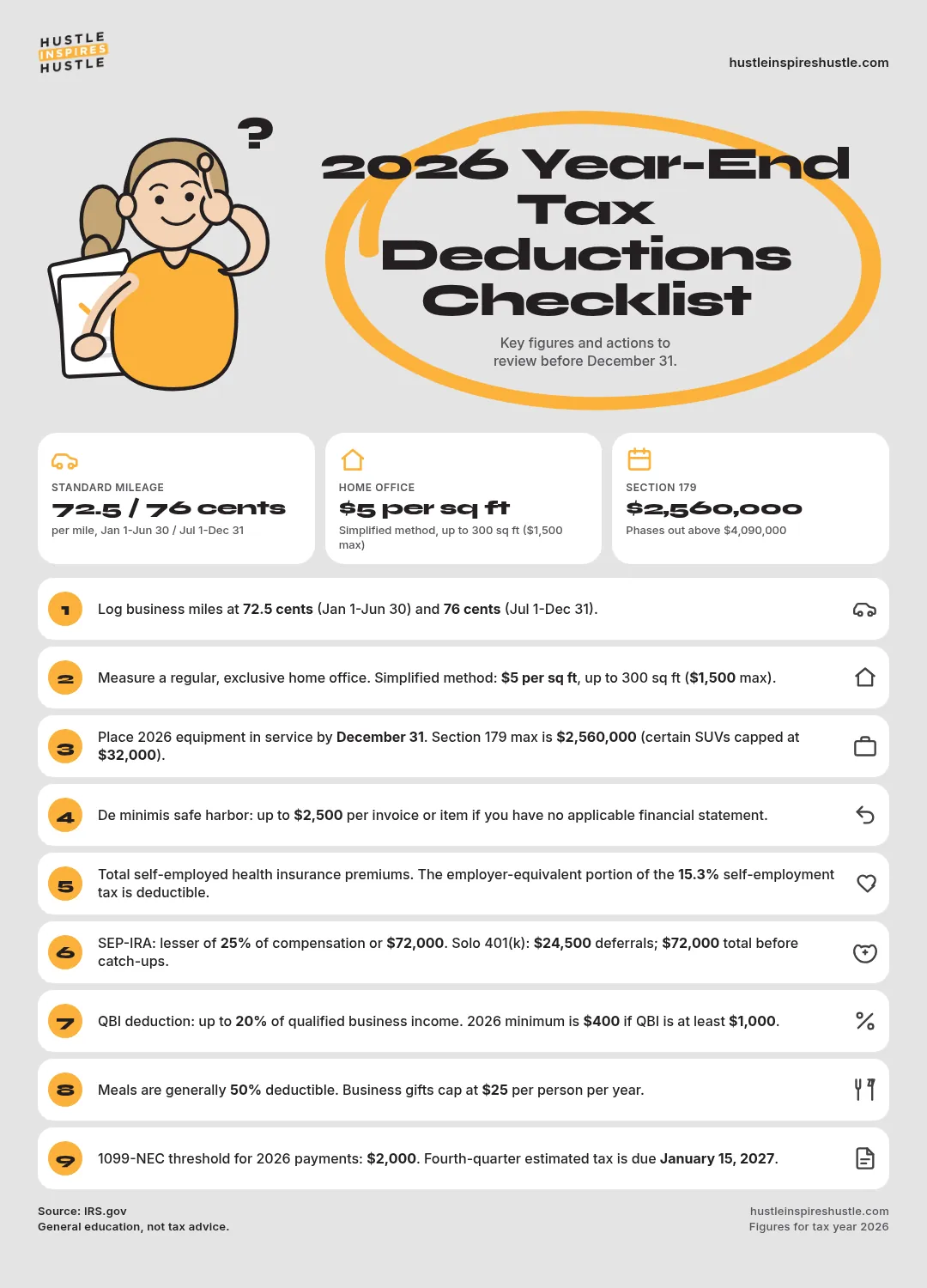
| Business mileage | Business driving, not commuting | 72.5¢/mile (Jan 1 to Jun 30); 76¢/mile (Jul 1 to Dec 31) | Standard mileage rates |
| Home office (simplified method) | Space used regularly and exclusively for business | $5 per sq ft, up to 300 sq ft ($1,500 max) | Simplified option |
| Section 179 expensing | Equipment placed in service in 2026 | Up to $2,560,000; phases out above $4,090,000 | Publication 946 |
| De minimis safe harbor | Lower cost tangible items, by election | Up to $2,500 per invoice or item (no applicable financial statement) | Tangible property regulations |
| Self-employment tax | Net SE earnings of $400 or more | 15.3% rate; employer-equivalent portion is deductible | Self-employment tax |
| SEP-IRA | Self-employed people and small employers | Lesser of 25% of compensation or $72,000 | SEP contribution limits |
| Solo 401(k) | Owner with no employees other than a spouse | $24,500 deferrals; $72,000 total before catch-ups | 401(k) contribution limits |
| QBI deduction | Qualified pass-through business income | Up to 20%; $400 minimum with at least $1,000 of active QBI; 2026 thresholds $403,500 joint / $201,750 most other filers | QBI deduction |
| Business meals | Meals with a clear business purpose | Generally 50% deductible | Publication 463 |
| Business gifts | Gifts to clients and contacts | Up to $25 per person per year | Publication 463 |
Figures checked against the linked IRS pages on November 17, 2026. Rev. Proc. 2025-32 is the source for the QBI minimum and the 2026 QBI income thresholds.
For trades and anyone driving to job sites, client homes, or shoots, this is often a top write-off.

For 2026, the IRS set two business mileage rates, according to its standard mileage rates page:
Because the rate changed mid-year, track how many business miles fall in each half.
A few rules that trip people up:
For HVAC and plumbing owners, the truck is basically the office. More on that side of the business in our guide on how to start an HVAC business.
Maybe. It's one of the most misunderstood deductions.

The IRS home office deduction page lays out two core tests:
- Regular and exclusive use. You must regularly use part of your home only for business. The guest room that's also your office? The kitchen table? Those usually don't pass.
- Principal place of business. Your home has to be your main place of business, or a place you regularly meet clients or customers, or a separate structure like a detached studio or garage that you use only for business.
If you qualify, you have two ways to figure it.
Simplified method. The IRS simplified option lets you deduct $5 per square foot of home used for business, up to 300 square feet. Do the math and the max is $1,500. Easy records, no depreciation to track later.
Regular method. You figure the percentage of your home used for business, then deduct that share of actual costs like rent or mortgage interest, insurance, utilities, and repairs, plus depreciation if you own. More paperwork, and sometimes a bigger deduction. Publication 587 has the full details.
You can pick either method each year, according to the IRS. But once you choose for a given year, you can't change methods for that year later.
Setting up a workspace that actually passes the "exclusive use" test is half the battle. Our home office setup guide can help you build a space that's clearly business only.
You need a new laptop, a camera, a commercial oven, a set of tools. Should you buy it in December or January?

The short answer: equipment generally counts in the year it's placed in service, meaning set up and ready to use in your business. Ordered on December 30 and still sitting in a warehouse on January 3? That's likely a 2027 item. Have this conversation with your CPA before you buy, not after.
Here's what the IRS has published for 2026:
For most solo founders and small crews, those caps are far above anything you'll spend. The real question is whether the purchase makes sense and whether expensing it all this year fits your situation. That's a CPA call.
The small purchase shortcut. The IRS also has a de minimis safe harbor for lower cost items. If you don't have what the IRS calls an applicable financial statement (many small businesses don't), you can elect to deduct tangible property up to $2,500 per invoice or item, as long as you treat it the same way in your books.
Think a printer, a ladder, or a small piece of kitchen equipment. It's an election, so make sure your tax preparer actually makes it.

Often, yes. Publication 334 says you may be able to deduct what you paid for medical and dental insurance and qualified long-term care insurance for yourself and your family. Depending on your situation, you may need Form 7206 to figure it.
Eligibility rules apply, especially if you or your spouse could get employer coverage, or if you claim the premium tax credit. Let your preparer sort it out.
If you're still figuring out coverage, read our self-employed health insurance guide.
Yes. When you work for yourself, you pay both halves of Social Security and Medicare. The IRS self-employment tax page puts the rate at 15.3%: 12.4% for Social Security and 2.9% for Medicare. You generally owe it once your net earnings from self-employment hit $400 or more.
The good news is you can deduct the employer-equivalent portion of your self-employment tax when figuring your adjusted gross income. That deduction lowers your income tax. It doesn't lower the self-employment tax itself.
This is one of the few moves where saving and cutting taxes go together. You're paying yourself, not a vendor.
Two common options for the self-employed:
SEP-IRA. According to the IRS SEP contribution limits page, contributions can't exceed the lesser of 25% of compensation or $72,000 for 2026. For a self-employed person, "compensation" is figured in a special way from your net earnings, so your real max is lower than 25% of your profit.
The IRS retirement plans for self-employed people page also says you can set up a SEP for a year as late as the due date of your tax return, including extensions. That makes it a good fallback if December slipped away from you.
One-participant 401(k) (often called a Solo 401(k)). The IRS one-participant 401(k) page explains that you contribute as both the employee and the employer. For 2026, per the IRS 401(k) contribution limits page:
A Solo 401(k) only works if you have no employees other than a spouse. The self-employed math has extra steps, and the IRS points to Publication 560 for the worksheets. Ask your CPA in November, not April.
Many first-year founders miss this one. The IRS QBI deduction page says eligible owners of sole proprietorships, partnerships, S corporations, and some trusts and estates may deduct up to 20% of their qualified business income.
A few things worth knowing:
There are income-based limits too, and they get complicated for some service businesses. For tax years beginning in 2026, Revenue Procedure 2025-32 sets the taxable income thresholds at $403,500 for married couples filing jointly (phase-in ends at $553,500) and $201,750 for most other filers (phase-in ends at $276,750). Married people filing separately have a $201,775 threshold (phase-in ends at $276,775).
Above those levels, wage and property tests can reduce the deduction, and some specified service businesses phase out. Let your preparer run the math. Just don't let this one get left off.
Want a checklist like this in your inbox every week? The Hustle Inspires Hustle newsletter sends founders practical money, marketing, and growth moves, minus the fluff. Join the HIH newsletter here. It's free, and you can leave anytime. |
The big items get attention. The small recurring ones get lost, and they're some of the most commonly missed self-employed tax write-offs. Here's where to look on your bank and card statements: If you freelance, the tax write-offs for 1099 workers are mostly this same list.
Two rules worth memorizing from Publication 463:
If you pay subcontractors, freelancers, or a part-time helper as a contractor, get your records in order now.
Publication 334 says that for reportable payments made after 2025, the information reporting threshold increases to $2,000. So for 2026 payments, that's the number to check against. Form 1099-NEC for nonemployee compensation is generally due to the IRS by January 31. The IRS points to Publication 1099 for 2026 filing details.
Before year-end:
If you work in a tipped occupation or you run a hospitality business, there is a temporary deduction for qualified tips. An IRS fact sheet on the Working Families Tax Cuts says eligible workers may deduct up to $25,000 in qualified tips for tax years 2025 through 2028, subject to income limits and reporting rules.
Self-employed workers may deduct qualified tips only up to their net income from the businesses where those tips were received, and the tips generally have to be reported on a Form 1099-MISC, 1099-NEC, or 1099-K. This rule is new and detailed. Do not estimate it yourself. Read the IRS fact sheet and talk to your CPA.
Only if you were going to buy it anyway.
It's the classic year-end trap. Founders hit a strong Q4, panic about taxes, and buy a truck or camera kit they don't need. The deduction lowers taxable income, but the cash is gone.
A better way to think about it:
- Did you already plan this purchase for early 2027? Pulling it into December may make sense. Check timing with your CPA.
- Would you buy it without the tax break? If not, skip it.
- Is a retirement contribution the better move? It lowers taxes and the money stays yours.
Also, prepaying next year's bills usually doesn't create a deduction this year. Publication 334 says you generally can't deduct expenses in advance, even if you pay them in advance. There are narrow exceptions, so ask before you prepay a year of rent.
If you use the cash method of accounting, Publication 334 says you generally deduct expenses in the year you pay them. A 2026 bill you pay on December 31 usually counts for this year. The same bill paid on January 2 usually counts for 2027.
Budgeting for taxes all year beats scrambling in December. If cash flow is a recurring pain point, read our post on the mistakes entrepreneurs make when budgeting.
If you work for yourself, nobody withholds tax from your income. That's why the IRS expects quarterly estimated payments.
According to the IRS estimated taxes page, individuals, including sole proprietors, generally have to make estimated payments if they expect to owe $1,000 or more when they file. The fourth payment for 2026 is due January 15, 2027, per the 2026 Form 1040-ES.
The same IRS page says most people avoid the underpayment penalty if they paid at least 90% of this year's tax or 100% of last year's, whichever is smaller. Higher earners have special rules.
The IRS recordkeeping page says you can use any system that clearly shows your income and expenses.
What works for most small businesses:
The IRS set two business rates for 2026: 72.5 cents per mile from January 1 through June 30, and 76 cents per mile from July 1 through December 31. Commuting from home to your regular workplace doesn't count. Keep a log made at or near the time of each trip. Source: IRS standard mileage rates.
Under the simplified method, you deduct $5 per square foot of home used regularly and exclusively for business, up to 300 square feet. That caps the deduction at $1,500. You skip tracking actual home costs and depreciation, but you still have to meet the IRS use tests. Source: IRS simplified option for home office deduction.
For tax years beginning in 2026, the maximum Section 179 expense deduction is $2,560,000. It starts shrinking once the cost of qualifying property placed in service during the year passes $4,090,000. Certain sport utility vehicles are capped at $32,000. Equipment generally has to be in service by December 31. Source: IRS Publication 946.
Often, yes. You may be able to deduct premiums for medical, dental, and qualified long-term care insurance for yourself and your family. Eligibility rules apply, especially if you could get coverage through an employer plan, and some people need Form 7206 to figure the deduction. Source: IRS Publication 334.
SEP contributions are capped at the lesser of 25% of compensation or $72,000. A Solo 401(k) allows $24,500 in employee deferrals, plus catch-ups at 50 or older, with a $72,000 overall cap before catch-ups. Self-employed math lowers your real maximum, so confirm your number with a CPA. Source: IRS 401(k) contribution limits.
No. A deduction only offsets part of what you spend, so buying something you don't need still leaves you with less cash. Buy what the business actually needs. If a planned purchase was coming in early 2027 anyway, ask your CPA whether moving it into 2026 makes sense.
For tax year 2026, the fourth estimated tax payment is due January 15, 2027. Sole proprietors generally have to make estimated payments if they expect to owe $1,000 or more when they file. Running your year-end deduction checklist first gives you a better estimate of what to pay. Source: IRS Form 1040-ES.
Yes, once the business has opened. You can elect to deduct up to $5,000 of start-up costs and up to $5,000 of organizational costs. Each $5,000 amount is reduced once those costs exceed $50,000, and any remainder is amortized. Source: IRS Publication 583.
Yes, but usually only the business-use share. If an expense is part business and part personal, you generally deduct only the business part, according to IRS Publication 334. Keep a reasonable basis for the percentage, and don't write off the whole family plan by default.
For reportable payments made after 2025, the information reporting threshold is $2,000, up from $600. Total what you paid each contractor in 2026, keep a Form W-9 on file, and note that Form 1099-NEC is generally due to the IRS by January 31. Source: IRS Publication 1099.
The best small business tax deductions checklist is the one you actually finish. Log your miles, measure your office, confirm your equipment is in use, total your health insurance, pick a retirement plan, and get your contractor records in order. Then book a meeting with your CPA before December 31 while you can still act on what they tell you.
For more official guidance, the IRS Small Business and Self-Employed Tax Center and the SBA's guide to paying business taxes are both worth bookmarking.
Want more straight-talk guides like this one? Every week, the Hustle Inspires Hustle newsletter shares practical playbooks for founders, side hustlers, and service business owners, plus real stories from people building businesses. Subscribe to the HIH newsletter and join our free community of founders who are building alongside you. |
Disclaimer: This article is for general informational purposes only and is not tax, legal, or financial advice. Tax laws change and every situation is different. Consult a qualified CPA or tax professional about your specific circumstances before acting on anything here.

Alex Quin is a full-stack marketing expert and global keynote speaker. Founder and Chief Marketing Officer of UADV Marketing - a member of the Forbes Agency Council.