Many adults consider themselves lifelong learners and pursue education outside formal classrooms. Approximately 73% report this approach to learning. This trend has fueled the rise of the general knowledge app — digital platforms designed to deliver bite-sized insights into history, science, philosophy, culture, and more. While the desire to learn is high, most modern learners face the productivity paradox: we have more access to information than ever, yet we struggle with chronic time poverty, decision fatigue, and a paralyzing volume of low-quality content.
A general knowledge app bridges this gap by filtering complex subjects into accessible formats that fit into your busy schedule. The following selections were curated after analyzing app store rankings, educational technology benchmarks, popularity, and user feedback, including research on information retention. The research focused on identifying platforms that cater to different learning styles. Let's review the list of such apps to see which format aligns best with your daily routine!
Nibble App: Start Reading and Watching Short Knowledge Lessons Across Different Topics
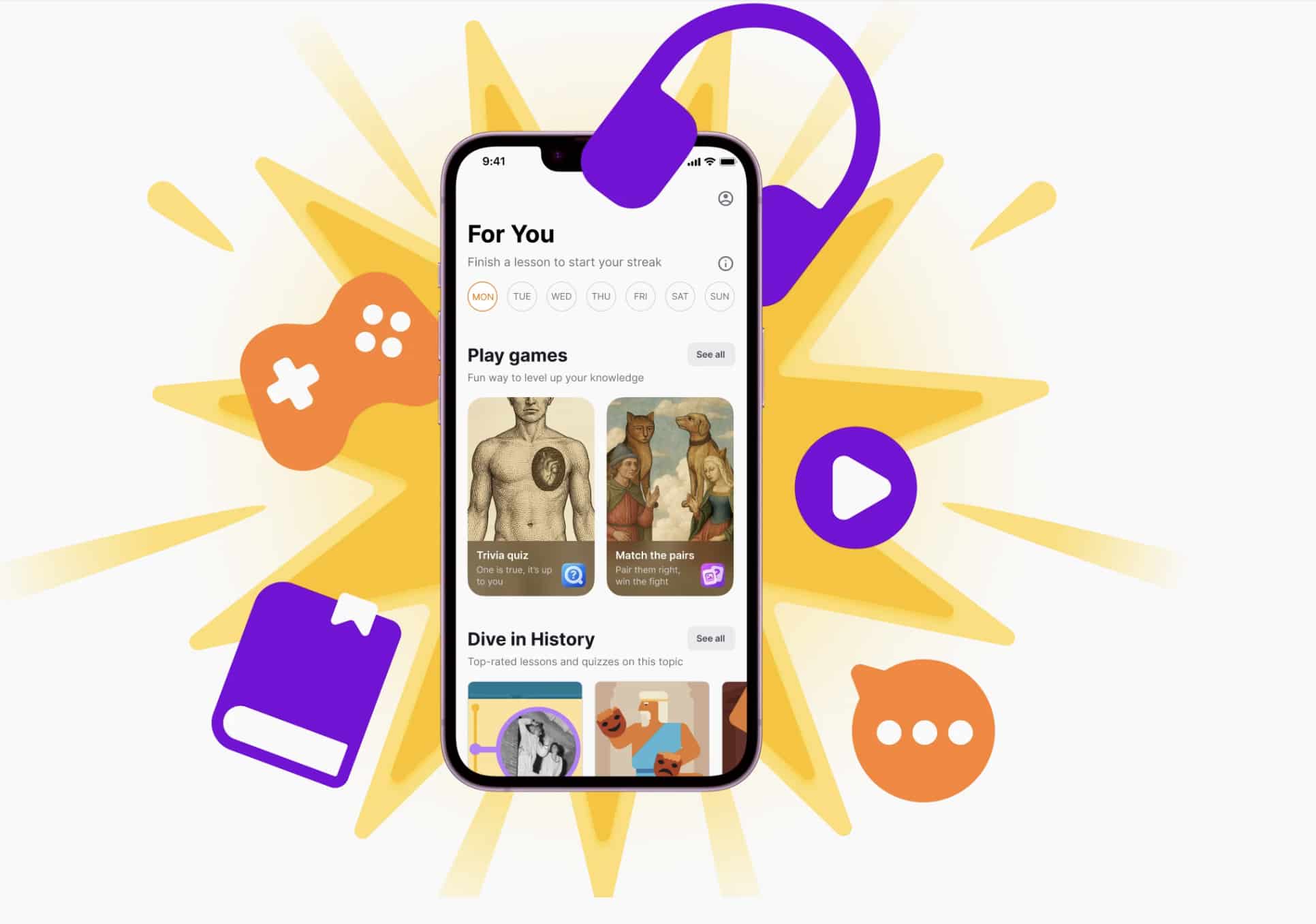
The Nibble app is a dedicated microlearning platform built for people who want to become well-rounded without the back-to-school or university pressure. It solves the common problem of wanting to learn complex subjects, such as Philosophy, Criminology, Art, History, and so on, without committing to a 400-page textbook or a semester-long course.
This approach is supported by learning science and published psychological data suggesting the use of microlearning. This method can improve knowledge retention by making information easier to digest and less overwhelming. You can spend ten or fifteen minutes on a Nibble that explains the psychology of procrastination or the evolution of the universe, and it also offers:
Key features: Lesson cards with visual diagrams, audio shortcasts for commuting, quizzes to help the knowledge stick.
Real-life use cases: You can finish a complete lesson on the history of revolutions while waiting for your morning coffee to brew.
Best for: Replacing doomscrolling with productive, interactive habits, and for continuous learning.
Wikipedia App: You Can Scan and Read Encyclopedic Articles Quickly
Many people check quick answers on AI platforms; however, you probably fact-check the data twice and ask for reliable sources. The verified references still require reliable sources. Wikipedia helps with this because its articles include references to sources below and citations and data from original research.
You can use it to quickly review background information on historical events, scientific concepts, public figures, and more. Just keep in mind that Wikipedia articles are written by volunteers, so anyone can create or edit an article. Most contributors are unpaid editors, some are experts, some are hobbyists, and some are simply interested readers. Therefore, as anyone can edit, Wikipedia has a solid system of community monitoring.
As the world's largest collaborative encyclopedia, Wikipedia is the gold standard for quick-reference learning, too. The mobile app version is optimized for rabbit-hole exploration, allowing you to jump from a page on quantum mechanics to Napoleon's biography in seconds. With over 6 billion monthly visits reported by Wikimedia, it remains the most significant repository of human knowledge ever assembled.
TED App: Just Watch Educational Talks Online
If you learn better by listening to experts tell stories, the TED app is essential. It hosts thousands of presentations from the world's leading thinkers, covering everything from behavioral science to technological ethics. With over 3 billion views, TED has mastered the art of the 'Idea Worth Spreading,' keeping most talks under 18 minutes to respect the human attention span, and offers:
Curated playlists by topic (e.g., How the mind works), downloadable video for offline viewing, and subtitles in different languages.
Watching a talk on body language while eating lunch to pick up tips you can immediately use in your next social interaction.
Spotify App: Listen to Knowledge Podcasts
While primarily known for music, Spotify has evolved into a powerhouse for educational audio. It hosts legendary general knowledge podcasts like 'Stuff You Should Know'. Audio learning is perhaps the most frictionless way to grow your brain because it doesn't require your hands or eyes, just your ears:
Passive learning during dead time, like commuting or exercising.
Key features: Playback speed control, sleep timers, and easy-to-organize playlists.
Quizlet App: You Review Knowledge Flashcards
The greatest enemy of general knowledge is the Forgetting Curve. It is a concept in psychology that describes how quickly people forget information after learning it if they do not review it again. Spaced repetition is the most efficient way to move information into long-term memory and help fight this curve. Quizlet uses digital flashcards to turn this science into a game:
You will memorize hard facts such as geography, scientific terms, and foreign vocabulary.
User-generated study sets, match games, and AI-powered practice tests.
Real-life use, like you can run through a 5-minute flashcard deck of world capitals while waiting in line at the grocery store.
Reddit App: Follow Knowledge Discussions
Reddit is often overlooked as a learning tool, but its communities (subreddits) like r/AskHistorians provide something books cannot: dialogue and stories from real people. With over 70 million daily users, you can find experts answering specific, niche questions that bridge the gap between academic theory and everyday understanding:
You can see different perspectives and get complex topics simplified by a community.
You can use topic-specific subreddits, Ask Me Anything (AMA) sessions with experts, and upvoted (vetted) comments.
You can browse a thread on how inflation actually works to see real-world examples and counter-arguments.
Headway App: Start Reading Nonfiction Book Summaries from Bestsellers
Many readers want to learn from influential nonfiction books but rarely have the time to finish a full 300–500 page title. The Headway app addresses this by condensing popular nonfiction books into short summaries that highlight the author’s main ideas and arguments. You get a book to read ideas for continuous learning, so you can read or listen to a condensed version that captures the central concepts.
The app focuses on topics such as psychology, leadership, productivity, personal finance, and history, all of which are good for general knowledge. Most summaries take about 15 minutes to read or listen to, making them suitable for short breaks or during commuting. Headway also includes spaced repetition features and short quizzes to reinforce key insights after reading.
Choosing and Testing a General Knowledge App for Daily Learning
Improving your general knowledge is about making curiosity a consistent part of your lifestyle. Whether you prefer the structured, interactive lessons of the Nibble general knowledge app, the deep-dive summaries at Headway, or ed-videos at TED, the key is to match the tool to your existing habits. Short, daily study sessions are far more effective for long-term growth than occasional, intense cramming sessions.
By integrating one of these tools into your downtime, you'll find yourself having more engaged conversations. It is about understanding the world with much greater clarity!
Alex Quin is a full-stack marketing expert and global keynote speaker. Founder and Chief Marketing Officer of UADV Marketing - a member of the Forbes Agency Council.
Join Our Premium Business & Marketing Community For Free!
Our insider community gives you access to a wealth of resources designed to elevate your branding, marketing, and content creation efforts. Access free courses, live calls, Q&As, and merch giveaways.
Thank you! Your submission has been received!
Oops! Something went wrong while submitting the form.


.jpeg)