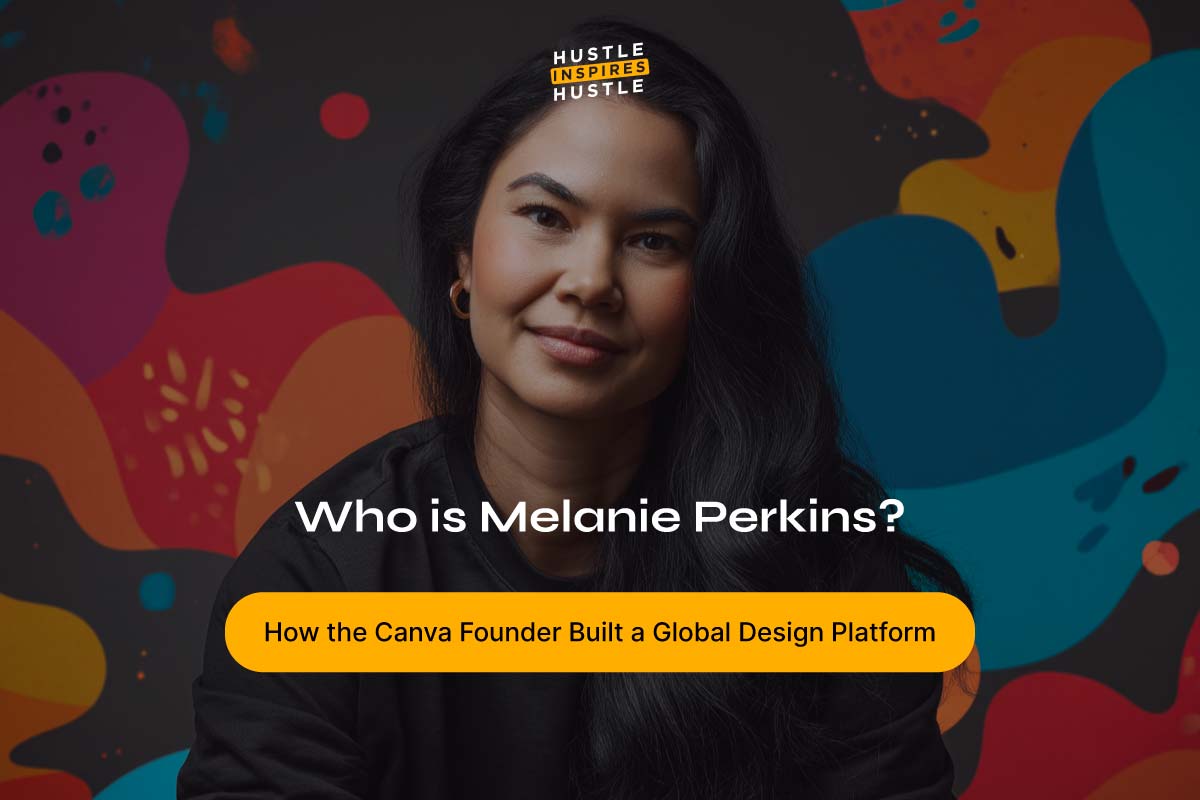
Who is Melanie Perkins? How the Canva Founder Built a Global Design Platform
Can design be as easy as drag‑and‑drop? Melanie Perkins believes so.
As co-founder and CEO of Canva, she turned a frustration with clunky software into a company that serves hundreds of millions of users. This article unpacks her biography, the product philosophy behind Canva, and the lessons founders can apply this week.
If you’re an entrepreneur, creative, or marketer looking to grow through product‑led and community‑driven strategies, read on.
Melanie Perkins is an Australian technology entrepreneur and one of the youngest female CEOs of a billion‑dollar tech company. She co-founded the online design platform Canva in 2012 with Cliff Obrecht and Cameron Adams and serves as its CEO.
Perkins leads product strategy, keeps simplicity at the heart of Canva, and advocates for making professional design accessible to everyone. Forbes lists her among the world’s richest self‑made women, yet she and Obrecht have pledged to give away most of their wealth.
At‑a‑Glance
Profile Overview Table
Focus
Details
Role
Co-founder & CEO of Canva; drives product vision and simplicity.
Mission
Empower everyone to design anything—make professional design approachable for non-designers.
Co-founders
Cliff Obrecht (operations/business) and Cameron Adams (product/technology).
Why she matters
Built a $42 billion company with over 240 million monthly active users and eight consecutive years
of profitability. She’s a role model for product-led growth and philanthropy.
Perkins’s story shows how starting small, listening to users, and removing friction can turn a niche solution into a global platform. In the next section, we follow her journey from teaching frustrations to founding vision.
Origins: From Teaching Friction to Founding Vision
Melanie Perkins grew up in Perth, Australia. As a teenager, she pursued figure skating and sold handmade scarves at local markets, which nurtured her entrepreneurial mindset.
She enrolled at the University of Western Australia to study communications, psychology, and commerce, but left at age 19 to pursue a startup.
While tutoring students in graphic design, she noticed it took an entire semester just to locate buttons in complex tools like Adobe Photoshop. She wondered why design software couldn’t be easier, online, and collaborative.
Perkins and her partner Cliff Obrecht lacked technical expertise and resources, so they started small. In 2007, the pair launched Fusion Books, an online editor that let schools design and print yearbooks using templates and drag‑and‑drop tools. Operating out of Perkins’s mother’s living room, they secured a small loan and hired a developer to build the prototype.
The system allowed entire classes to collaborate on pages, then the couple printed and delivered yearbooks around Australia. Fusion Books grew into Australia’s largest yearbook provider, proving there was demand for simpler design software.
Turning Pain Into Product
Perkins observed three recurring pain points among her students:
Complexity – design programs were intimidating and required weeks just to learn the interface.
Access – licences were expensive and limited to certain labs, preventing collaborative work.
Time to results – students spent more time learning tools than creating designs.
These insights shaped Canva’s core features.
Instead of menus and toolbars, Canva uses drag‑and‑drop editing and preset templates to simplify creation. Web‑based collaboration and a freemium model remove access barriers. The goal is a fast time‑to‑first result, enabling users to produce a professional design in minutes.
If you’re building a product, start by listing your top five user frictions; pick two to remove this week.
Building Canva: Narrow Solution to Global Platform
Melanie Perkins' strategy began with a niche yearbook tool and grew into product-led growth at Canva. She and Cliff Obrecht pitched a simple online design platform and heard more than 100 rejections. Investors doubted the Canva founder and her partner as romantic co-founders without technical backgrounds and worried about backing an Australian startup.
Perkins kept sharpening the story. She learned kitesurfing to attend a venture-capital retreat, met Bill Tai and Lars Rasmussen, and through Rasmussen, recruited ex-Google designer Cameron Adams as the third co-founder.
Canva launched publicly in 2013 only after the product met Melanie’s bar for design accessibility. Early Canva templates gave users one fast first win: create and share a design in a few clicks. Over 50,000 signups in the first month confirmed product–market fit and powered both product-led and community-led growth.
Product Philosophy: Simplicity, Templates, and Confidence
Perkins often says that simplicity isn’t minimalism; it’s prioritization for user outcomes. By removing unnecessary options and guiding users through templates and inline coaching, Canva makes design feel attainable. Perkins saw that people were anxious about blank canvases, so she created a vast library of templates and tutorials.
This “teach, don’t gatekeep” approach turns learning into a loop. Users learn a concept, create a design, share it, and then come back for more.
Canva now layers AI into that loop: tools like AI-powered design suggestions, writing assistance, and quick resize features help people move from idea to finished asset even faster, without needing expert skills.
Canva continually expands its template library (now covering everything from TikTok ads to internal HR documents) and uses guided flows to build confidence.
The company invests heavily in localization, supporting over 100 languages to make the product feel local everywhere. In 2017, the team rewrote the entire codebase (Editor 2), delaying new features for 2 years to enable collaboration and video editing; a long‑term bet that paid off when Canva introduced video editing and other complex tools.
As product builders, ensure your architecture can support future ambitions even if it slows immediate output.
Teach, Don’t Gatekeep
Canva’s education strategy (tutorials plus templates) reduces anxiety and drives shareable results. A simple loop any startup can replicate:
Tutorial: create a short guide or walkthrough that teaches one outcome (e.g., “design your first social media post”).
Template: provide a ready‑to‑use starting point so users don’t face a blank canvas.
Showcase: encourage users to share their creations; spotlight them on your channels to celebrate their success.
This cycle builds confidence and reinforces your community. Measuring success through user outcomes (time to first result, completion rate) matters more than vanity metrics.
Canva’s growth has been product-led: the tool itself markets the company, reflecting Melanie Perkins' leadership and the broader product-led growth Canva strategy.
The freemium model gives users immediate value, while premium plans unlock team collaboration and advanced features. Tutorials and templates amplify organic growth, and new features are engineered for virality. Perkins focuses on metrics like “projects started from content” rather than page views, so content strategy stays tied to creation, not just clicks.
Community plays an equally important role. With millions of users worldwide, Canva’s templates and user-generated designs spread through social media, classrooms, and small businesses.
The platform features user stories, encourages feedback, and ships improvements quickly. Many Canva alternatives now copy pieces of this playbook, yet few match the same combination of breadth in templates, design accessibility, and a truly global community that keeps feeding new use cases into the product.
In March 2024, Canva acquired Affinity (a professional design suite) and now offers its tools free to nonprofits, students, and teachers, a clear example of Melanie Perkins' leadership using generosity to build goodwill while expanding the ecosystem.
Playbooks You Can Copy (No Big Team Required)
Publish content regularly – aim to release one tutorial and two new templates each week. Include a clear call to action, such as “create now.”
Track meaningful metrics – measure how many projects start from your content and the percentage of users who complete a design.
Spotlight your community – feature user creations, highlight success stories, and incorporate feedback into product updates.
These tactics work because they focus on user outcomes and build community ownership. Whether you’re a solo founder or a small team, you can implement similar loops.
Leadership & Culture: How Melanie Perkins Operates
Melanie Perkins' leadership centers on clarity, kindness, and high standards. She personally onboards every new employee, sharing Canva’s origin story and vision for design accessibility at scale.
Team lunches work as a simple ritual that strengthens connection and culture.
Perkins structures the company around “crazy big goals” instead of rigid hierarchies; each team selects an ambitious objective and celebrates once they reach it. Inside Melanie Perkins Canva, operational simplicity stays non-negotiable. Weekly reviews, often called “simplicity standups”, give teams space to discuss which friction they removed, what shipped, and what confused users.
Outcome-based scorecards tie performance to user success. Perkins still spends time in customer support so she can stay close to user pain points and protect empathy in every decision.
Operating Rhythms to Steal (Lightweight)
Weekly simplicity stand‑up – ask: What did we remove? What shipped? What confused users?
Outcome‑based scorecards – measure team output based on user results (e.g., time to first result, active projects), not internal deliverables.
Founder support hour – spend one hour each week answering support tickets or watching user sessions to stay grounded.
Canva’s impact extends beyond design. It enables non‑designers to produce professional work, from marketing materials and school presentations to small‑business branding.
By 2024, the platform had 185 million active users and saved companies like FedEx and Workday tens of thousands of hours. Students in more than 60 million classrooms and over 600,000 nonprofits use Canva’s tools for free.
Perkins and Obrecht also use their wealth for social impact. They signed the Giving Pledge and committed to donating more than 80% of their stake to the Canva Foundation, which supports poverty‑alleviation initiatives. Their philanthropic work includes providing direct cash transfers to families in Malawi, believing that “cash gives people the freedom to choose what matters most to them”.
Why This Model Resonates
Useful tools, not hype – Canva built trust by delivering valuable tools rather than marketing slogans. User‑centric design and continuous improvement won loyalty.
Community stories – spotlighting user success stories creates durable distribution and social proof.
Diverse scenarios – Canva empowers classrooms, small businesses, and creators alike, showing that a versatile platform can scale across use cases.
Challenges & Tradeoffs (Educational, Not Gossipy)
Simplicity versus power is Canva’s perpetual balancing act. Advanced users sometimes crave more control, while new users need guidance. To manage this, Perkins measures whether simplifying workflows actually improves outcomes and uses guardrails to ensure templates remain flexible.
Scaling a global platform also demands careful localization.
As the Canva founder story expands from one Australian startup to a worldwide tool, translating the product into over 100 languages required large investments in cultural adaptation and support. Meanwhile, platform breadth versus focus remains an open question. Canva’s push into documents, websites, and videos could dilute its core if those bets drift too far from its original mission.
The Founder’s Checklist
Measure the impact of simplification – did removing a step improve user success?
Template guardrails – provide flexibility with brand controls to prevent sameness.
Mission filter – say no to features that don’t advance the mission of democratizing design.
Apply It This Week: A 7‑Day “Melanie Perkins” Sprint
Want to emulate Perkins’s user‑centric approach? Here’s a week‑long sprint for solo founders and small teams:
Step‑by‑Step
Day 1–2: Watch three users complete your core task. Note every friction point.
Day 3–4: Remove two steps; add a preset or template; rewrite confusing microcopy.
Day 5: Publish a three‑minute tutorial. Link it inside your product.
Day 6–7: Measure time to first result and completion rates; share outcomes with users and ask for feedback.
By the end of the week, you’ll have a clearer picture of user pain points and a simple process to reduce them, just like Canva.
FAQs: Melanie Perkins & Canva
Who Is Melanie Perkins?
Melanie Perkins is the co-founder and CEO of Canva, the visual communication platform used by hundreds of millions worldwide. She is known for turning complex design workflows into simple, template-driven experiences so non-designers, students, and teams can create professional graphics, documents, and videos without traditional design training quickly, in minutes.
How Did She Come Up With the Idea?
She discovered the idea while tutoring students in graphic design at university and watching them struggle through intimidating, complex software. To fix that frustration, she imagined a simple, browser-based, collaborative editor. She first tested the concept with Fusion Books for school yearbooks, then expanded the model into Canva, used globally.
What Is Her Product Philosophy?
Her product philosophy is to make the first successful outcome fast, obvious, and delightful so users experience value immediately. She relies on templates, education, and clear workflows instead of heavy sales. If people can quickly create something they love, they return, invite teammates, and effectively market Canva themselves to others.
Does Melanie Perkins Still Own Canva?
Yes. Melanie Perkins and her co-founder Cliff Obrecht reportedly still own a significant stake in Canva, estimated around one-third each. They have pledged to donate the vast majority of their shares over time through the Canva Foundation, channeling future wealth into philanthropic and social impact initiatives supporting education and equality.
Is Canva Owner Filipino?
Canva’s co-founder is Australian. Melanie Perkins was born in Perth to an Australian teacher mother and a Malaysian-born engineer father of Filipino and Sri Lankan heritage. So she has Filipino ancestry through her dad, but she grew up in Australia and identifies primarily as Australian, with culturally mixed family roots.
Does Melanie Perkins Have a Child?
Yes. Melanie Perkins and her husband and co-founder, Cliff Obrecht, welcomed their first child in early 2022. Becoming a parent coincided with leading a rapidly scaling global company, adding a new perspective on time, priorities, and the kind of long-term impact they want Canva to have on people, communities, and planet.
What Can Founders Copy Right Now?
Founders can borrow her playbook: start with a narrow problem, validate it deeply, and use templates plus education to help users win quickly. Remove friction relentlessly, measure outcomes like successful projects instead of vanity traffic, and design a freemium loop that rewards sharing, collaboration, and community-led growth at every stage.
How Melanie Perkins Redefines Modern Leadership
Melanie Perkins’s journey from a university tutor frustrated with clunky design software to the CEO of a multi-billion-dollar company offers invaluable lessons. Focus on solving real user problems, make simplicity your north star, build a community around your product, and set audacious goals that feel slightly out of reach.
Her story also shows the value of patience and resilience, refining your vision after every “no” instead of abandoning it. Finally, remember that success is not only about wealth; Perkins exemplifies how business growth can fund meaningful social impact, support education, and expand access to creativity for people who once felt locked out of design.
As an entrepreneur, you can even start a home business with Canva itself by creating niche templates, social media kits, or printable products and selling them on platforms like Etsy while you build your skills and audience. You can also gift a Canva subscription to a friend, collaborator, or family member, giving them a ready-made toolkit to launch their own side hustle or creative projects.
Elevate your entrepreneurial game with actionable advice and inspiring interviews from high-level entrepreneurs, business owners, and overall badasses in the game. Get more insight and inspiration on our blog posts, podcast episodes, or invite-only community.
Alex Quin is a full-stack marketing expert and global keynote speaker. Founder and Chief Marketing Officer of UADV Marketing - a member of the Forbes Agency Council.
Join Our Premium Business & Marketing Community For Free!
Our insider community gives you access to a wealth of resources designed to elevate your branding, marketing, and content creation efforts. Access free courses, live calls, Q&As, and merch giveaways.
Thank you! Your submission has been received!
Oops! Something went wrong while submitting the form.