What the Spirit Airlines Closing Means for Every Business Owner Watching
Spirit Airlines didn't just stop flying on May 2, 2026. It became the first major U.S. airline in 25 years to fully shut down for financial reasons, and the lesson lands at every desk, not just at airports. The Spirit Airlines closing story is the kind of business story that looks like it's about airlines until you realize it's about every business model that competes only on price.
People often ask what happened to Spirit Airlines. The short answer is that a 34-year-old business model ran out of room when bigger competitors copied its playbook, and a fuel shock closed the gap. The longer answer is the kind of teardown every entrepreneur should pin to the wall.
This is a Hustle Inspires Hustle breakdown of how the closure happened, why the business stopped working, and which lessons translate from a 17,000-employee airline down to a four-person agency or a solo creator brand. The death of a major brand always gets eulogized. Almost no one extracts the operating lessons in time for the next founder to use them. For a deeper look at how to think about this kind of structural risk, our piece on building a defensible business moat walks through the same logic in a smaller-business context.
What Happened to Spirit Airlines, in Plain English
Spirit Airlines ceased operations at 3 a.m. ET on May 2, 2026, after talks for a $500 million federal bailout collapsed and bondholders rejected the deal. Spirit didn't fail overnight. It failed in slow motion across five years, with the final 72 hours just being the part everyone watched.
The numbers anchor the story. The shutdown affected 17,000 direct and indirect jobs, including 14,000 Spirit employees and thousands of contractors, according to CNN Business. The airline had 34 years of operating history and was the first major U.S. airline to face a shutdown for financial reasons since Midway in 2001.
There is also a critical distinction between Chapter 11 and a full wind-down that most founders blur together. Chapter 11 is a form of bankruptcy protection that lets a company restructure its debts and keep operating, buying time to find a path forward. Spirit had filed for that protection twice since 2024 and survived. This time it didn't.
Bankruptcy and a full shutdown are not the same event, and treating them as the same is one reason founders miss the warning signs in their own businesses. Knowing what happened sets up the more useful question, which is why it happened. That is where the lessons live.
The Final 72 Hours, Bailout, Bondholders, and the Wind-Down
Spirit's final stretch came down to a rejected bailout from a key creditor group, despite advanced talks with the Trump administration on a $500 million rescue package that would have given the government an equity stake. Bondholders rejected the deal because the bailout would have placed the government ahead of their existing claims, a textbook capital-stack conflict that founders rarely see this clearly outside of business-school cases.
The operational dominoes are also instructive. Spirit canceled international flights first to keep crews and aircraft from being stranded abroad, then stopped all flights at 3 a.m. ET, then shut down customer service.
Here's what most people don't realize. By the time a company announces it's shutting down, the decision is already weeks old. The public moment is the last domino, not the first.
How a 34-Year-Old Business Model Stopped Working
Spirit invented the U.S. ultra-low-cost playbook. Strip everything out, charge for every add-on, and sell the cheapest base fare in the market. The model worked for decades because no one bigger was willing to copy it.
Then, American, Delta, and United introduced basic economy fares in the 2010s, which structurally erased Spirit's price gap on overlapping routes.
Post-pandemic travelers also started paying up for comfort, lounges, and bundled experiences. The customer the model was built for shrank. When your differentiator is something a bigger competitor can copy, your moat is rented, not owned.
Why Spirit Airlines Failed and Five Root Causes Every Founder Should Recognize
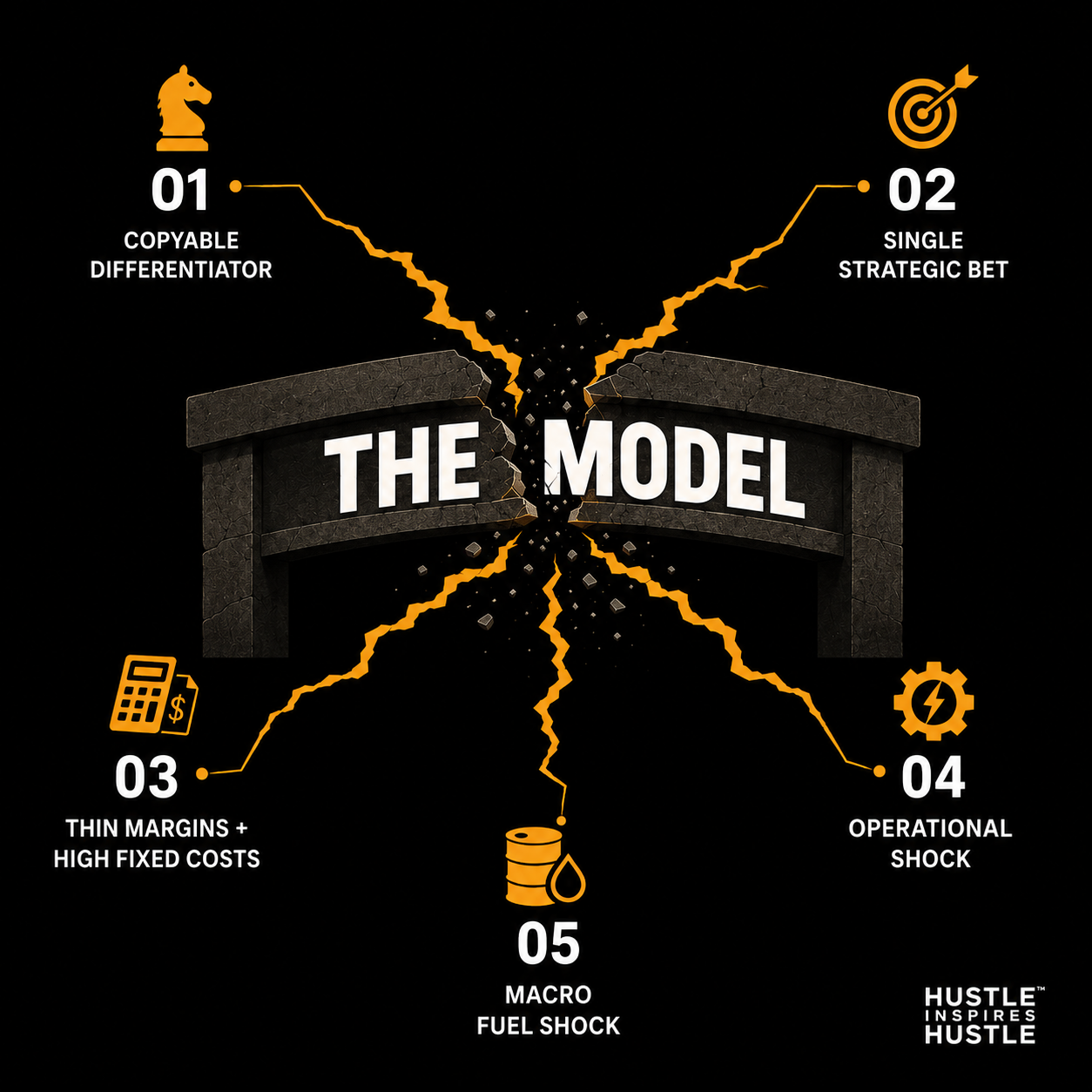
In five points, here is what brought Spirit Airlines down, and why each one shows up in small businesses long before they hit a runway problem. Mainstream coverage lists the same five causes. We name them as patterns that founders see in their own businesses every quarter.
Cause 1, A Differentiator That Bigger Players Could Legally Copy
Spirit's ultra-low-cost model relied entirely on price. When American, Delta, and United introduced basic economy, Spirit's only meaningful edge against legacy carriers collapsed. If your edge is price, lower cost, faster turnaround, or simply charging less, the question to ask every Monday morning is what happens when a better-capitalized competitor matches that number.
The brand reputation kicker is also worth flagging. Spirit ranked low in major brand-reputation polls before the shutdown. Cheap pricing without an emotional brand layer creates customer resentment, not customer loyalty. The difference between a moat and a margin is whether your customer would still choose you if a competitor matched your price tomorrow.
Cause 2, All-In on a Single Strategic Bet, the JetBlue Merger
When the post-pandemic recovery faltered, Spirit's strategic pivot was a $3.8 billion merger with JetBlue. The U.S. Justice Department blocked it on antitrust grounds, and Spirit was left without a Plan B.
The moment a company stakes survival on one acquirer, one investor, one platform, or one channel, it has stopped controlling its own outcome. Diversification of revenue, distribution, and partnerships is a form of risk management, not paranoia.
Cause 3, Capital-Intensive Operations With Thin Margins
Airlines run on razor-thin margins with massive fixed costs such as aircraft leases, fuel, and labor, which means even small revenue dips produce large cash crises. Capital-intensive operations are reality for more than just physical equipment businesses. SaaS founders carrying long-term cloud commitments, agencies on retainer payroll, restaurants on rent and supplier contracts, all feel the same dynamic when revenue softens.
Spirit's track record made this worse. The company hadn't posted a profitable year since 2019 and lost over $2.5 billion between 2020 and 2024, per CBS reporting. A business doesn't fail when it stops making money. It fails when it stops making money long enough to run out of options.
Cause 4, Operational Shocks Outside the Founder's Control
Spirit was hit by the Pratt & Whitney engine recall, which grounded dozens of its jets and hammered capacity utilization at the worst possible time. Every business has a P&W moment. A key supplier fails, a platform changes its API, a key team member leaves, or a payment processor freezes the account.
The lesson here is not that you can prevent shocks. It is whether you have the cash and operational redundancy to absorb them. If your single biggest revenue source disappeared next month, how many months of runway do you have? If the answer is less than six, the Spirit lesson applies.
Cause 5, A Macro Shock the Balance Sheet Couldn't Absorb
Spirit's 2026 restructuring plan assumed jet fuel near $2 per gallon. The Iran war pushed prices to roughly $4.51 per gallon by late April. The model never had a chance against that gap. Every plan assumes some baseline cost, such as ad rates, shipping, raw materials, or contractor wages. Founders should pressure-test the model against a 50% adverse swing on at least one major input.
Spirit's competitors faced the same fuel shock and survived because they had more diversified revenue, higher-yield routes, and stronger balance sheets. Same shock, different outcomes. The difference was preparation. Spirit's failure was a fragile system meeting an ordinary shock and breaking on contact, not a single catastrophic event.
Five Business Lessons From the Spirit Airlines Closing
Here is what most entrepreneurs should take from the Spirit Airlines closing. Five lessons that apply whether you run an airline, an agency, or a one-person creator business.
Lesson 1, If Price Is Your Only Edge, You're Renting Your Moat
A price-only differentiator is the easiest competitive position to copy and the first one to break under pressure. Build at least one defensible layer above price, such as brand, community, expertise, IP, or distribution. Action this week: write down your top three reasons a customer chooses you. If all three reduce to "cheaper or faster," your moat is rented.
Lesson 2, Diversify Your Strategic Bets Before You Need To
Spirit bet survival on the JetBlue merger. When it was blocked, there was no Plan B. Founders should always have a second viable path, a second customer segment, a second channel, or a second product line. Action this week: identify your single biggest dependency, whether one client, one platform, or one product line, and sketch what the next 90 days would look like if it disappeared tomorrow.
Lesson 3, Brand Reputation Is a Balance Sheet Item
Spirit was the cheapest option and one of the most disliked brands in America. When they needed customer goodwill, public sympathy, or political capital for a bailout, the bank account was empty. Action this week: audit how customers describe your brand in unprompted reviews. If the language is transactional, like "cheap," "fast," or "good price," you are building margin, not equity.
Lesson 4, Stress-Test the Model Against Realistic Shocks
Every business plan assumes a baseline. The founders who survive shocks are the ones who pressure-tested the model against adverse swings before they happened. Action this week: run a 50% adverse swing on your largest variable cost and your largest revenue source. If either scenario kills the business in under six months, you have a fragility problem to solve.
Lesson 5, Cash Buys Time, and Time Buys Options
Spirit ran out of options because it ran out of cash and runway in a high-cost industry. Cash is an option-creation mechanism, and holding it gives you the ability to adapt when the model gets stressed.
Action this week: calculate your true runway in months, assuming zero new revenue starting today. If the number is under six, the strategic priority for the next quarter is cash, not growth. Cash doesn't make you rich. Cash makes you patient, and patience is the rarest competitive advantage in business.
The Hustle Inspires Hustle Take and Why This Story Matters Beyond Aviation
Airline failures keep producing the most useful business lessons in the market because the math is brutally clean. Every variable runs at scale, so when something breaks, you can see exactly which lever snapped. The Spirit Airlines closing snapped on identity, and it ties directly to the recurring Hustle Inspires Hustle thesis. Durable businesses are built on identity differentiation, distributed risk, and operating discipline, not on chasing a single advantage. Alex Quin, a working CMO and Forbes Agency Council member who runs UADV day to day, reads stories like this as an operator analyzing another operator, which is what makes the lessons transfer.
Here is the lesson scaled down. Spirit's identity was "cheap," and "cheap" is the easiest position in any market to copy. The restaurant version is a concept that brands on price per plate. The agency version is a shop that wins pitches on rate. The DTC version is a brand that competes on discount code. In every case, the day a better-funded competitor matches the number, the business has nothing left to defend. UADV's work in hospitality and brand-led marketing keeps surfacing the same pattern, and the fix is always the same. Build at least one layer above price, whether that is a brand the customer can describe in a sentence, a community the competitor cannot clone, or a product experience that costs more to copy than it earns to imitate. If you cannot name that layer in your own business today, that is the audit worth running this week.
Readers who want more business teardowns like this one can subscribe to the Hustle Inspires Hustle newsletter or listen to recent podcast episodes on resilience, brand differentiation, and capital efficiency.
What Happens Next for the U.S. Airline Industry and What Founders Should Watch
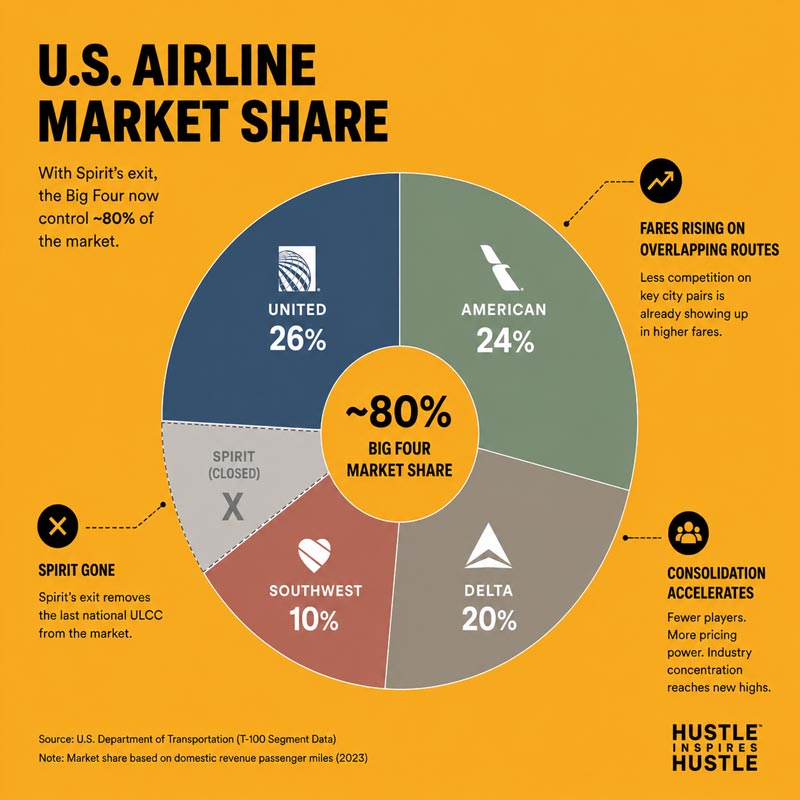
In the short term, fares on overlapping routes will rise. In the long term, the Spirit Airlines closing is a signal flare for any business model that depends on a price-only edge in a consolidated industry.
The immediate consumer impact is real. United, Delta, JetBlue, and Southwest agreed to cap rescue fares at around $200 for stranded Spirit passengers, per CNN Business reporting. With Spirit gone, four major carriers, United, American, Delta, and Southwest, now control roughly 80% of U.S. flights available to passengers. In any maturing market, the second wave of consolidation eats the discount challengers first.
The businesses that thrive in maturing markets are built on identity, balance-sheet discipline, and customer relationships that survive a shock. Industry watchers covering the airline space at the U.S. Department of Transportation will be tracking this consolidation closely over the next 18 months.
Conclusion: The Lesson the Spirit Airlines Closing Leaves Behind
Every generation of founders inherits a few cautionary tales. The Spirit Airlines closing will be one of the case studies that entrepreneurs in 2030 study to understand the 2020s. The closing goes beyond fuel costs and bondholders. At its core, it is a story about identity, fragility, and what gets revealed when an ordinary shock meets a thin margin.
The five lessons are stuck in one sentence each. Rented moats break. Single bets fail. Brand is a balance-sheet asset. Stress tests are mandatory. Cash buys patience.
In summary, Spirit didn't just stop flying. It left every founder watching with a checklist of five questions worth answering before the next macro shock arrives.
Subscribe to the Hustle Inspires Hustle newsletter for ongoing business teardowns like this one, or listen to recent podcast episodes covering brand differentiation, founder resilience, and capital efficiency. The founders who learn from other people's failures pay tuition only in time. The ones who don't pay it in jobs, equity, and 34 years of brand history.
Frequently Asked Questions
Why is Spirit Airlines closing?
Spirit Airlines is closing because a 34-year-old ultra-low-cost business model stopped working. Legacy airlines copied their pricing strategy, post-pandemic travelers shifted toward comfort, a Pratt & Whitney engine recall grounded jets, and the Iran war doubled jet fuel prices. When a $500 million federal bailout fell through, the airline ran out of runway.
When did Spirit Airlines shut down?
Spirit Airlines ceased operations at 3 a.m. ET on May 2, 2026, after talks for a federal rescue package collapsed. International flights were canceled first to keep crews from being stranded, followed by all domestic flights and customer service. It was the first major U.S. airline shutdown for financial reasons since Midway in 2001.
Is Spirit Airlines coming back?
Based on the wind-down structure announced on May 2, 2026, Spirit Airlines does not appear to be returning as an operating airline. The company filed for bankruptcy twice since 2024 and could not find a buyer or secure a bailout the second time. Its fleet, gates, and routes are being absorbed by other carriers.
What can entrepreneurs learn from the Spirit Airlines closing?
The biggest lesson from the Spirit Airlines closing is that a price-only differentiator is the easiest competitive position to copy and the first to break. Spirit's collapse also illustrates the danger of betting survival on a single strategic move, the importance of stress-testing your model against shocks, and the value of brand reputation.
Will airfare go up because of Spirit Airlines' closing?
Yes, especially on routes Spirit serviced. Research has shown Spirit's presence on a route lowered competing fares significantly, and consumer advocates warn fares are likely to rise on overlapping routes. Other airlines are offering capped rescue fares around $200 in the short term to help stranded passengers rebook on alternative carriers.
Was Spirit Airlines profitable before it shut down?
No. Spirit Airlines hadn't posted a profitable year since 2019 and lost over $2 billion between 2020 and 2024, according to NPR's reporting. The airline filed for Chapter 11 bankruptcy in November 2024, restructured, and then filed again in 2025 before finally winding down operations completely in May 2026 after the bailout failed.
How does the Spirit Airlines closing affect small business owners?
The Hustle Inspires Hustle take is that the Spirit Airlines closing is a teardown every business owner should study. The same dynamics, a copyable differentiator, single-point-of-failure strategy, thin margins, and macro shocks, show up in agencies, restaurants, e-commerce brands, and creator businesses. The lessons translate even when the operating scale doesn't.
Alex Quin
Entrepreneur. Podcaster. Go-Getter.
Alex Quin is a full-stack marketing expert and global keynote speaker. Founder and Chief Marketing Officer of UADV Marketing - a member of the Forbes Agency Council.
Join Our Premium Business & Marketing Community For Free!
Our insider community gives you access to a wealth of resources designed to elevate your branding, marketing, and content creation efforts. Access free courses, live calls, Q&As, and merch giveaways.
Thank you! Your submission has been received!
Oops! Something went wrong while submitting the form.