Best Apps for Stress Relief: A Founder’s Guide to Relaxation
It is 2 a.m., and your brain will not stop. The launch is nine days out, the inbox refilled itself twice since dinner, and your shoulders have been somewhere up near your ears since Monday. You do not need a lecture on self-care. You need something that works in the ten minutes you can actually spare.
There is data behind the late nights and stress as an entrepreneur. A University of California, San Francisco study led by Dr. Michael Freeman, published in the journal Small Business Economics in 2019, found that 72 percent of the entrepreneurs surveyed reported mental health concerns, a markedly higher rate than the comparison group. Stress comes with the territory. A fast, repeatable reset is the edge.
The best apps for stress relief are not one-size-fits-all. The right one depends on how you are stressed, and a founder's stress rarely looks like the stress these apps were built to sell. A racing mind needs a different tool than an overloaded calendar.
People often ask what the best app for stress relief is when you do not even have ten minutes to sit still. The honest answer is that it depends on what your stress is doing to you, in your body, and on your to-do list.
Most roundups hand you the same five meditation apps and call it a day. This guide sorts tools by the four ways builders burn out, including the productivity apps nobody files under stress relief, but every founder feels relief from.
At Hustle Inspires Hustle, we talk to founders who treat burnout as a strategy problem rather than a personality flaw, so this list is built for the way you work.
First, What Kind of Stressed Are You? (The 60-Second Diagnostic)
Here is what most people miss. Stress is not one thing, and the wrong app is just one more thing draining your battery.
Founder stress usually shows up in one of four ways. Read these, and you will know your category in about a minute.
Racing mind. Your thoughts will not slow down, especially at night. You replay conversations and pre-live tomorrow's problems on a loop.
Can't stop working. Resting feels like guilt, and the background hum of unfinished tasks never quite goes quiet.
Physical tension. Stress hits your body first, in a tight chest, a clenched jaw, or shoulders that have not dropped in days.
Decision fatigue and depletion. By afternoon, you are fried, every small choice feels heavy, and the motivation tank reads empty.
Mechanism is the whole game. A breathing app can settle your physiology in a few minutes, but it will not clear a 200-item to-do list. A task app empties the list, but it will not slow a pounding heart. Match the tool to the mechanism, and you stop wasting downloads.
The rest of this guide is sorted by these four types, so skip to yours.
One caveat before we start: these are everyday stress patterns, not diagnoses. If what you are carrying runs deeper than a hard week, that is a different conversation, and there is a note on it near the end.
Why "Just Download Calm" Is Bad Advice for Founders
The default recommendation everywhere is a meditation app. If your stress is an overloaded workload, sitting in silence can feel like one more task you are failing at.
Builders abandon meditation apps fastest because the format fights their wiring. A restless, output-oriented mind resents being told to do nothing, then files the skipped session as another small failure.
That is why this guide includes focus and productivity apps. For a lot of entrepreneurs, a sense of control over the chaos is the stress relief, no incense required.
Best Apps for a Racing Mind (Anxiety, 2am Spirals, Can't Switch Off)
The difference between a racing-mind app and a sleep app is timing. One interrupts the spiral now, the other prevents it tonight.
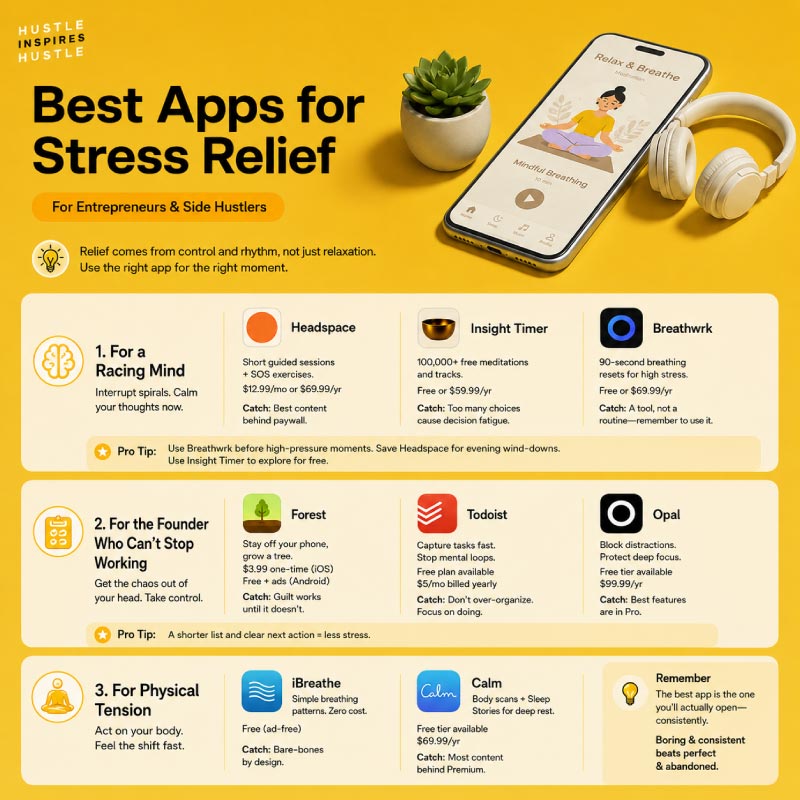
If you have ever lain awake mentally rewriting an email you already sent, this is your category. Here are three meditation apps for stress relief that earn their place, with the honest catch on each. Pricing is current as of June 2026, and these numbers change, so confirm before you subscribe.
Headspace
Best for: Headspace is for founders who want structure and a clear path instead of a library to get lost in.
Standout feature: short guided sessions and quick SOS exercises you can run between meetings.
Cost: free trial, then about $12.99 per month or $69.99 per year .
The catch: the best content sits behind the paywall, and the upbeat tone is not for everyone.
Insight Timer
Best for: Insight Timer is forthe budget-minded builder who wants range without committing a cent.
Standout feature: one of the largest free libraries in the category, with well over 100,000 free guided meditations and tracks.
Cost: free, with a Member Plus plan around $59.99 per year, roughly $5 a month, for courses and offline play.
The catch: the sheer size triggers decision fatigue, which is its own small stressor.
Breathwrk
Best for: Breathwrk is best forthe 90-second reset when your heart is racing before a pitch.
Standout feature: fast guided breathing patterns that give the mind a concrete job, easier than meditation for restless founders.
Cost: free core exercises, with Breathwrk Pro around $69.99 per year and a 7-day trial.
The catch: it is a tool, not a routine, so you have to remember to open it.
Use Breathwrk in the 90 seconds before you go on camera. Save Headspace for a real evening wind-down. Reach for Insight Timer when you want to try ten teachers before paying for one.
The Free Option That's Genuinely Good
Insight Timer is the strongest free pick here. Its free library covers most of what a beginner needs before you ever bump into a paywall, which is rare in this category.
The catch is real, though. The huge catalog feeds decision fatigue. Counter it by choosing three sessions and repeating them for a week instead of browsing every night.
This fits the founder budget mindset: prove the habit free before you pay for polish. If you still open it after two weeks, then upgrade.
Best Apps for the Founder Who Can't Stop Working
Here is what most wellness roundups miss. For a lot of entrepreneurs, the most effective stress relief app has nothing to do with meditation. It is the one that gets the chaos out of your head and onto a screen.
Relief often comes from a restored sense of control and rhythm, not from relaxation. Moving tasks out of your skull and into a system you trust lowers the background hum of what am I forgetting. These are stress relief apps in disguise.
Forest
Best for: Forest is great for the doomscroller who needs a reason to leave the phone alone.
Standout feature: start a focus session and a virtual tree grows; leave the app early and it dies, which turns focus into a small, satisfying game.
Cost: a one-time $3.99 on iOS, or free with ads on Android plus a small one-time unlock. No subscription.
The catch: the guilt mechanic works until it does not, and some people just let the tree die.
Todoist
Best for: Todoist is forthe founder whose stress is really just unsorted, unfinished work.
Standout feature: fast capture from anywhere, so a 2 a.m. thought lands in a trusted place instead of looping in your head.
Cost: a genuinely usable free Beginner plan; Pro runs about $5 per month billed annually, roughly $60 a year.
The catch: it is easy to over-tune. If you spend more time organizing than doing, the tool has turned on you.
Opal
Best for: Opal is forbuilders who cannot self-enforce a break or a hard stop.
Standout feature: scheduled focus sessions that block distracting apps, plus screen-time data that is uncomfortable in a useful way.
Cost: a limited free tier, with Pro around $99.99 per year.
The catch: the features that actually help, like deep focus and unlimited sessions, mostly sit in the paid tier.
This execution-over-theory thinking is exactly what the Hustle Inspires Hustle audience already runs on. For this crowd, relief looks like a clear next action and a shorter list.
When a Productivity App Becomes a Stress Trap Instead
Any system you over-tune becomes its own stressor. If you spend more time color-coding tasks than completing them, the tool has quietly become the problem.
Pick one capture tool, keep the setup boring, and resist the quarterly urge to migrate to whatever is trending. Boring and consistent beats elegant and abandoned.
How do you know it is helping? Simple. If opening it lowers your shoulders instead of raising them, keep it.
Best Apps for Physical Tension (When Stress Lives in Your Body)
Breathing and grounding apps work fastest, with many people feeling a shift within a few minutes, because they act on the body directly rather than the thoughts. Slow breathing nudges the parasympathetic nervous system, the body's rest-and-digest mode, which lowers heart rate and eases the physical signature of stress. The National Center for Complementary and Integrative Health, part of the NIH, describes this as the relaxation response: slower breathing, lower blood pressure, and a reduced heart rate.
iBreathe
Best for: iBreathe is great for founders who want zero setup and zero cost.
Standout feature: clean, customizable patterns like box breathing and 4-7-8, with an Apple Watch version for breathing on the go.
Cost: free and ad-free, with optional in-app purchases (iBreathe, as of June 2026).
The catch: it is bare-bones by design, with no courses or coaching.
Calm
Best for: Calm is for winding the body down at night, when tension and a racing mind show up together.
Standout feature: body-scan relaxations and Sleep Stories that give a restless brain something to follow.
Cost: a limited free tier, with Premium around $69.99 per year (Calm, as of June 2026).
The catch: most of the library is behind Premium, so confirm you will use it at that price.
These are the apps you run with headphones in before a pitch, on a commute, or in a parked car between meetings. Fast, private, no setup. If you want the science, the systematic review of research on slow breathing in Frontiers in Human Neuroscience lays out how it shifts the nervous system.
How Hustle Inspires Hustle Thinks About Stress (and Why It's Not "Hustle Harder")
The line between burnout and sustainable building is whether you treat recovery as a weakness or a system.
The name sets an expectation of grind, and the reality is more sophisticated. At Hustle Inspires Hustle, the point was never to work until you break. It is to build the systems, including stress systems, that let you keep going.
That lens comes from the founder. Alex Quin started Hustle Inspires Hustle and also runs the marketing agency UADV, so he talks about output the way a working operator does, as a resource you manage deliberately rather than a heroic act of will. Stress tools, in that frame, are maintenance, not indulgence.
Apps are one layer in a larger operating system. The tool handles the in-the-moment reset, and the routine around it does the real work. That is why no single app in this guide is the whole answer on its own.
Do Stress Relief Apps Actually Work, and How to Make One Stick
The short answer is yes, for in-the-moment regulation and habit-building. An app you never open does nothing, though, and no app replaces real support when stress becomes unmanageable.
Think of an app as a doorway, not a hallway. You open it, do the thing, and get back to your life. The failure mode is letting a wellness app become one more feed that adds noise instead of removing it.
To make one stick, keep it to three steps:
Pick one app matched to your stress type. One, not five.
Anchor it to an existing habit, like right after standup or just before bed, so you do not rely on motivation.
Review after two weeks and keep it only if it lowers the load.
One boundary, said plainly and not buried: these tools support wellbeing, they do not replace professional care. If stress or anxiety feels persistent, overwhelming, or unmanageable, talking to a licensed clinician is the right next step.
The entrepreneurs who sustain output are not the ones who never feel stress. They are the ones with a fast, repeatable way to reset.
The Best Stress Relief App Is the One You'll Actually Open
The best apps for stress relief are not ranked one through five. They are matched to how you, specifically, burn out.
Quick recap: a racing mind goes to breathing and meditation, can't-stop-working goes to focus and task tools, physical tension goes to breathwork, and depletion goes to boundaries and routine.
In a year when every productivity gain seems to arrive with more noise, the founders who win are the ones who build recovery into the system instead of treating it as failure.
In summary, the right stress relief app is the smallest tool that gives you the biggest sense of control, plus the discipline to open it again tomorrow.
Want the systems side of this? Go deeper with the Hustle Inspires Hustle podcast for founder-stress and execution conversations, and join the community for the ongoing version. Build the recovery in before you need it.
Frequently Asked Questions
What is the best app for stress relief?
There is no single best app, because the right one depends on how your stress shows up. For a racing mind, a meditation or breathing app like Headspace or Insight Timer works best. For an overloaded schedule, a focus or task app like Forest can deliver more relief than meditation. Match the tool to your stress type instead of chasing the top-rated download.
Are there free apps for stress relief?
Yes, and several are genuinely useful. Insight Timer offers a large free library of guided sessions, iBreathe is free for breathing exercises, and many other apps include free core tools. Prove the habit with a free version before paying for premium polish.
Do stress relief apps actually work?
For in-the-moment regulation and building a calming habit, yes. Breathing and grounding tools can shift how your body feels within a few minutes. An app only works if you open it, though, and none replaces professional care when stress becomes unmanageable. Treat it as a doorway, not a cure.
What's the best stress app if I don't have time to meditate?
Look at breathwork and focus apps instead of meditation. Breathing apps reset your physiology in a few minutes with no quiet-mind requirement, and productivity apps lower stress by restoring control over your workload. Both fit a packed day better than a 20-minute sit.
How does Hustle Inspires Hustle recommend founders handle stress?
Hustle Inspires Hustle frames stress as a systems problem, not a willpower one. The goal is building repeatable recovery into how you work, rather than grinding until you break. Founder Alex Quin talks about managing your output like any other resource, deliberately rather than heroically. Apps are one layer of that system, and the routine around them does the heavier lifting.
Can a productivity app really count as stress relief?
For many entrepreneurs, yes. Stress often comes from the background hum of unfinished, unsorted work, so getting it out of your head and into a trusted system lowers that load directly. Just avoid over-tuning the system itself. If organizing takes longer than doing, the tool has become the stressor.
When should I stop relying on an app and get real help?
Apps are built for everyday stress and habit-building, not clinical support. If stress or anxiety feels persistent, overwhelming, or unmanageable, that is the signal to talk with a licensed clinician. Using an app in the meantime is fine, but do not let it stand in for care you actually need.
Alex Quin
Entrepreneur. Podcaster. Go-Getter.
Alex Quin is a full-stack marketing expert and global keynote speaker. Founder and Chief Marketing Officer of UADV Marketing - a member of the Forbes Agency Council.
Join Our Premium Business & Marketing Community For Free!
Our insider community gives you access to a wealth of resources designed to elevate your branding, marketing, and content creation efforts. Access free courses, live calls, Q&As, and merch giveaways.
Thank you! Your submission has been received!
Oops! Something went wrong while submitting the form.